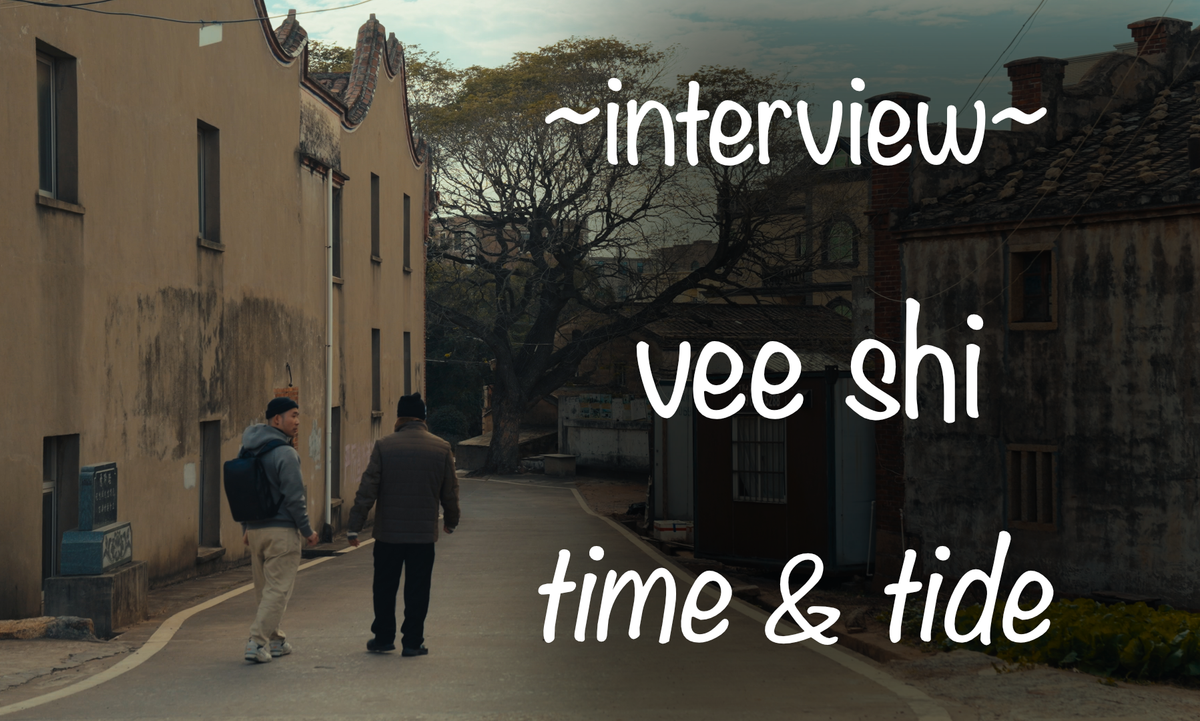
Interview: Vee Shi and Time & Tide
After a win at the Sydney Film Festival, the director spoke to Helena about finding the film...
Conducted by Helena Williams
Taking home the Documentary Australia Award at the Sydney Film Festival this year, Vee Shi’s Time and Tide is a stunning and inquisitive portrait of familial relationships. Its observational style and slow pacing allow the story to carefully unfold in what feels like real time, immersing audiences in a vulnerable exploration of the dynamics of intrafamilial duty and care. It subtly poses many questions to the audience and prompts the kind of deep introspection that continues long after the credits roll, and into the way you understand your relationships with others.
If it’s not obvious enough by now, I am in absolute awe of this film and cannot recommend it enough. I was lucky enough to interview Vee; below is said interview.
When I watched Time and Tide at Sydney Film Fest, you said there were originally sci-fi elements, and it was a scripted film. It was quite different to what it is now. How did you end up with the film as it is today and were there any big aha moments that turned it into a documentary?
I realised what was really different was the intention. The intention originally was to make a narrative fiction that also has sci-fi elements, and we ended up with a documentary, but I think the theme of the story remained the same.
The transition wasn't deliberate or conscious at all because when I originally wrote the screenplay, I knew that my family couldn't act, so I picked moments from their routine that I thought would make a narrative fiction work. My original plan was to get them to recreate those moments, almost like reenactments, but then order them differently. Then we realised that they couldn't act, so our pivoting moment was thinking maybe we just needed to find moments of them still being themselves that would tell the same story.
It really became a documentary throughout the editing process because we realised to tell a story that will feel truthful and resonate, the sci-fi elements just didn't work, so we had to take them away.
As we were editing, we had to strip away things that were scripted or had a lot of deliberate intention because they just felt awkward; like my mom would look at the camera to see where her marks were. It just didn't work. So, we just had to take them away.
I think in the process of pursuing what was more truthful and powerful, it just became a documentary.
There was one aha moment: the moment of my sister and my dad at the end because my sister originally wasn't a big part of the story. It was always about my parents, and then she came home and that big moment happened and everybody was so affected by it. We decided that moment has to be at the end; it has to be the anchor of the film, and so we realised for that moment to be really meaningful, we have to build her life into the story. We left my parents’ city early, and we went to my sister's city where she worked, and we built in moments to tell the audience who she is.
That makes sense, that moment was so powerful because of all the layers of context. On the editing process, was it strange to edit a version of yourself that you maybe didn't recognise or resonate with anymore?
Interestingly enough, during edits, I was always so detached from myself and from my family, I had to consciously tell myself that's me, that's my parents; otherwise, I’d just forget. I was always focusing on whether a scene told the story and how it would help the whole narrative.
During the first one or two cuts I tried to insert myself into the story a little bit more because I felt like the audience needed a point of view and that point of view was me. Almost like I had to lead them into the story. The more that I edited, the more I realised that it's not really my story; it's really me observing my family.
I had to add that voice-over at the start because we did a test screening and people just got really confused. I think because of that I had to write the voice over at the start just to contextualise the family and how I’d been away and hadn’t seen them for so long. That distance that you feel that my character has in the film is just me being very distant from my family because I have been away for like over 20 years.
I feel like your voice comes through very powerfully in the lens of the film rather than physically being in it or telling us things.
That was the intention, and it took me so long to get there. The editing process was difficult for me because I just didn't know how to tell a story where the point of view is clear. I think we had like 14 different cuts, and only after the 10th edit, I realised, oh, I just have to do a voice-over. Someone told me to do voice-over in the first cut. I was like, "No, I don't want voice over" and then I gave in and said, "Okay, I'll do a voice over." And then it worked.
The film intimately explores the tension between caregiving from a place of duty and from a place of love. I’m really interested to hear your thoughts on how you think these two things coexist within a family dynamic.
That's a great question because it's something that I experienced a lot, and I hadn't really thought about before.
Caregiving for your parents is a big thing in Chinese culture. It's ingrained in you and almost becomes a moral compass. It’s something you have to do; otherwise, you'll be frowned upon by the community.
With my mum, it was so clear that I love her so much. When it came to my dad, I was always unsure whether I was doing this because I love him or if I was doing this because it’s expected of me. I just felt like I have to do it, but I wasn't sure whether it was out of love or out of care.
After I made the film, once I got to know my dad a little more, I realised I loved him more than I thought I did. Which I only realised through the making of the film. So, to answer your question, there's probably no clear line of whether it comes from duty of care or love. I think it's always together and then blurred. Some days one will be over another, but I think over time that changes as well.
So, right now I definitely love my dad more than I did, but then he's no longer here.
That was a beautiful response. I feel like they coexist too, duty can be love.
Yeah, because love is an easy word to say, but to put it into practice comes down to the actions you take, and those actions could come from different things. For my mum, I just felt like the love for my dad was no longer there, and then she purely did that out of duty. Then for my sister, she loved him so much, but at the same time, she hated it, looking after my dad. After my dad passed, she was the most devastated person I had ever seen, I had never seen somebody so devastated. There was just so much contradiction there, and I feel like for me what was important for the film is that that contradiction existed.
My last question is basically about amplifying underrated cinema gems. What are your top three films that you feel have flown under the radar.
I have four!
That's great!
The first one is the 2007 film The Home Song Stories by Tony Ayres. I feel it was just so ahead of its time. If it were released now, it would garner so much more attention. So that’s an Australian film, and I think people need to see it.
And then the next one is a Norwegian film. It's called The Innocents by Eskil Vogt. That one is a supernatural horror film, but it's very grounded in reality, which I love, because I'm working on a supernatural horror as my next feature film.
And then a Chinese film. It's called So Long My Son by Wang XiaoShuai. It won a lot of international awards. I don't know if it'll be considered “under the radar”, but a lot of people I talked to haven't seen it. So, I thought I'd send it to you as well.
And then the fourth one is a short film. It's a Romanian film called The Joys and Sorrows of Young Yuguo by Ilinca Calugareanu, which is on Netflix. It's one of the most beautiful documentaries I've ever seen. It's only 28 minutes. And don't read anything before you watch it. Just watch it and see where that takes you.
Amazing! Thank you so much. That was pretty much all my questions and everything….
I have one more question here from you. I don't know if you still want to.
Oh my god… I missed one.
Yeah I just wrote some notes because I get rambling…
Oh, my goodness. No, thank you. I'm so sorry. I forgot one of my own questions.
It's all good, I've got it here. It says "Has your perspective of your family or their perspective of each other shifted with the filmmaking process and after watching the final product?”
I can't believe I forgot that because I wanted to ask you that at the screening!
Well, first of all, they haven't seen the film, so I can't answer the question for them. They just did the film and forgot about it. They know it exists, but they never asked to see the film.
So I can speak for myself.
I think this film changed my life in the best way possible. I had been away for so long, and I hadn’t been with them since I was 13. I'd never spent time with them as an adult. Even though I know that I love my family, it's quite distant, and then the connection has always been so superficial.
With the making of the film, I had to know who they are as characters. I spent two years watching them on screen, trying to understand them and figuring out who they are so I could tell their stories on screen.
That really allowed me to understand them from an adult perspective, not just from a son looking up at his mum. Before making the film, I think I was almost egotistical in a way. Because I have more education and travel experiences and other things, I thought I knew more than them, which is not true, and I only realised that after making the film. Our experiences are so different even though we came from the same family, same place. I shouldn't force my ideology and opinions on them, especially my mom, because I always used to think, I know more, I know better, you should do this, you should do that, and I don't do that anymore. I remind myself, you shouldn't talk to your mum like that; just because she might not have gone to school, it doesn't mean that she's not intelligent. So, for me that's changed forever.
I can even see that in how tenderly you characterise them, I always think of the scenes of your mom and her doing her exercise classes. It makes a lot of sense that you spent a lot of time getting to that point because it doesn't just happen. You must understand someone to present them in an authentic way.
Yeah thank you. That's a beautiful question so, I wanted to answer it.
It’s really fascinating that they haven’t seen it. Do you think they’ll ask you to see it?
Probably not. They just haven't shown any interest. Maybe in 10, 20 years they might want to see it.
I think our current generation spends so much time online, and a lot of our life is presented online and is being perceived by a lot of other people. We always care about how we are going to be presented on screen. For my mum especially, she’s just not in that world, she did it because she loves me and wanted to support me. Once we finished filming, her part was done. She didn't care about it anymore.
You’ve made a beautiful film, and I'm so glad you reminded me about that question. I would be kicking myself if I didn't ask you. Thank you so much for your time and congratulations. It's a beautiful testament to Australian cinema and to you.
Thank you.
Time & Tide is screening at the Melbourne International Film Festival.
Pick of the Week
This week I really recommend you head to the Sydney Cinematheque and see either Nightshift or Losing Ground. Two incredibly rare opportunities to see these films on the big screen and both are presented by guest curators.
New Releases - Thursday 13 August
- Case 137 (Dominik Moll)
- One Night Only (Will Gluck)
- Stop! That! Train! (Adam Shankman)
- The End of Oak Street (David Robert Mitchell)
- Tom and Jerry: Forbidden Compass (Zhang Gang)
Want a weekly guide that tells you what's happening on Sydney screens? Subscribe (for free) to get hand-picked recommendations or follow the Fleapit on Instagram to see the highlights of each week!
Comments ()