
'Yurlu | Country' by Yaara Bou Melhem (2025)
S. Andrew: This documentary is not simply recounting Elder Parker’s story. It is a direct call to action. A plea to continue his work. To save Country.
Watched by S. Andrew
The wealth of Hancock Prospecting, BHP, and other mining giants is built on devastation of land. Their fortunes are carved from the earth by tearing open its skin, gouging vast wounds into Country until the land itself gasps for breath. Mining in Australia isn’t just the removal of resources from rock; it cuts into the soul of the earth. The pain reverberates outward, through the hills, the rivers, the flora and the fauna. And because Country is inseparable from its people, that pain seeps into its people too. The sickness of the land becomes the sickness of those bound to it.
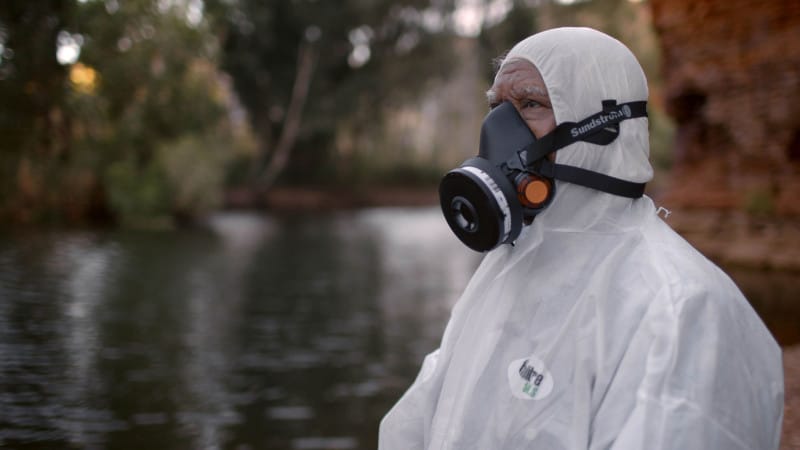
Yurlu | Country tells the story of Banjima Elder Maitland Parker, a man who has spent his life fighting to heal his Country from the continued poison of capitalist greed and colonial government neglect. His Country is hurting, and so is he. In 2016, Elder Parker was diagnosed with mesothelioma, an aggressive cancer caused by repeated exposure to asbestos. He was not an employee of the Wittenoom asbestos mines, but a ranger in the adjacent Karijini National Park for decades. Employed in 1985 as one of the first Banjima rangers, he was exposed to the poison for decades before his diagnosis. His body carries the scars of Wittenoom, the mine that poisoned Karijini National Park, poisoned Banjima Country, and is continuing to poison its people. As such, the Banjima community now refer to Wittenoom as ‘Poison Country.’
The hills of Wittenoom are no longer walkable. They are poison mountains, layered with asbestos so thick that even approaching them requires masks and suits, barriers against the air itself. Even with this equipment, fencing and signage prohibit entry on to the lands. Since the mine’s closure, Elder Parker has been locked out of the land that raised him. Just beyond the fence sits the birthing tree, where Elder Parker entered the world, and a site that for thousands of years has been central to Banjima women’s business and knowledge. And now, access is prohibited and life‑threatening.
This cultural dispossession is inseparable from the physical transformation of the land, where asbestos tailings have accumulated into vast formations that almost resemble the mountains of volcanic rock. They appear like a monstrous tumour infecting the earth. It looks shockingly natural, but it’s clear they are not of the land. The mountains are the result of mass toxic waste dumping, the work of Hancock Prospecting.
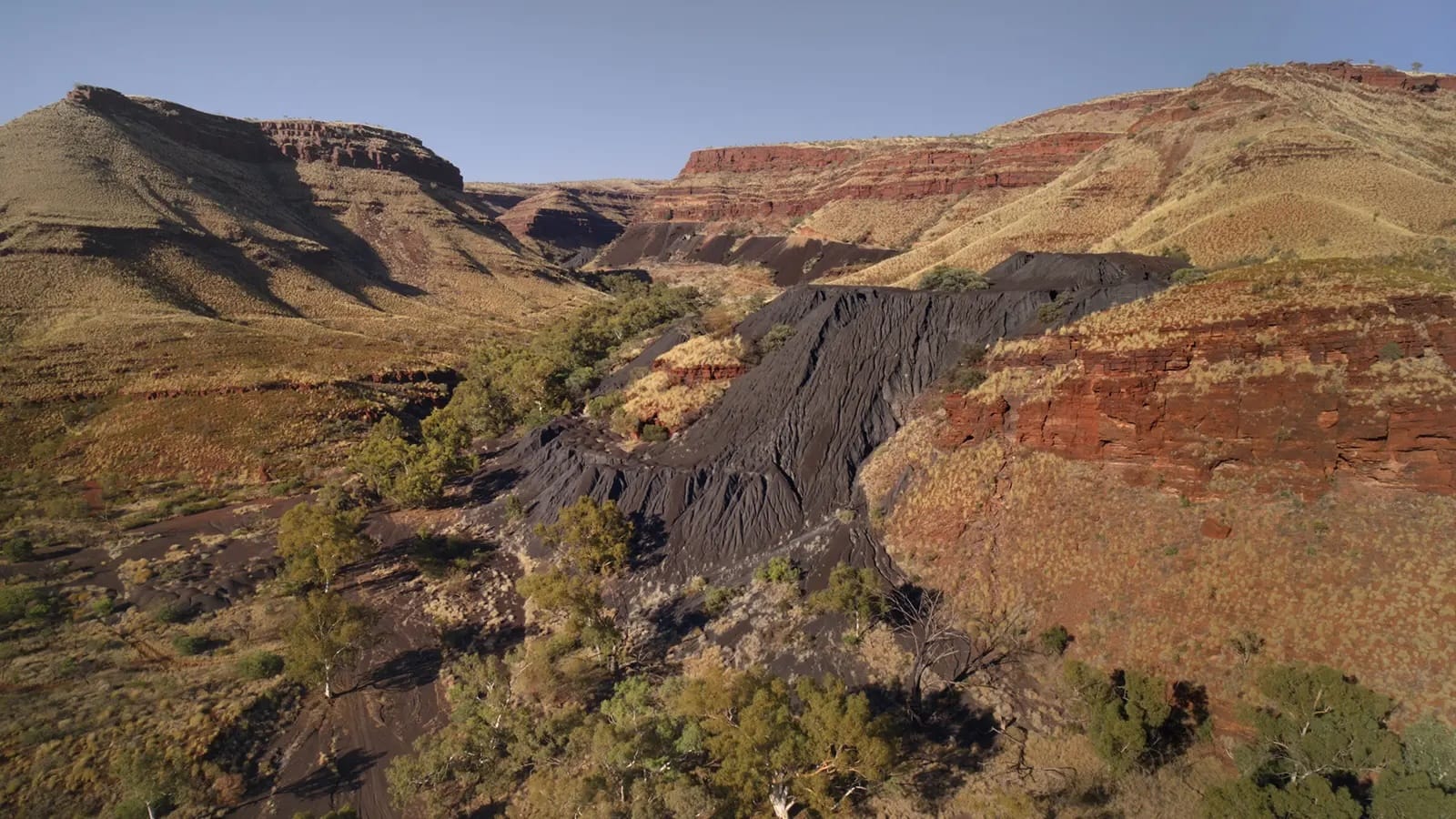
Their exploitation created the largest contaminated site in the southern hemisphere, frequently described as “Australia's very own Chernobyl.” And it took just 23 years for Hancock Prospecting to create it. When the Wittenoom mine was finally shut down, it was not because workers were dying of asbestos poisoning, nor because the Banjima community was suffocating under the dust. It was because Australian suburban homeowners began to fear asbestos in their walls and stopped purchasing the material for new home builds. In the end, it was profit, not the welfare of the people, that dictated the closure of the mine.
Award‑winning human rights journalist Yaara Bou Melhem directs her first feature‑length film with such visual sincerity and deep understanding. When she began researching for this documentary, her intention was to make a film about the 60,000 abandoned mines across Australia and their impact on the environment and public health. But her project shifted after meeting Elder Parker, whose fight to heal Poison Country became the central story of the film. Bou Melhem’s direction animates the words and knowledge of Elder Parker and the Banjima community in such a beautiful way. She breathes life into the visuals of the land she films. The camera lingers on Karijini’s biome, from its sweeping hills to its smallest creatures. It highlights the delicate rhythms that are shared between the land of Banjima Country and its diverse life. Much like the symbiotic relationship between Country and its people, Bou Melhem brings such a tangible visual life to the land she’s filming. The land feels like a lung, inhaling and exhaling life into everything around it.
This beautiful depiction of Banjima Country is juxtaposed with harrowing imagery of local mining operations. Gargantuan machines tear into the earth, the violence of extraction spliced against the calm of the landscape. The montage feels horrific and relentless. Elder Parker’s incredible storytelling and Bou Melhem’s direction reinforce the horror we’re watching. Like a wretched mechanical death that’s feeding off the living organisms of the world around it. Draining life from its surroundings. Like a cancer. The same cancer that is killing Elder Parker.
Through the length of this documentary, we witness his immense strength. Throughout his life, he has stood against destruction of his land. He has fought to heal his country. Fighting for his ancestors, for his descendants, for the possibility of healing. He knows his own time is short. He hurts. But he accepts. He knows he will return to Country in another form, carried forward through his people and through the land itself.
This documentary is not simply recounting Elder Parker’s story. It is a direct call to action. A plea to continue his work. To save Country. A call to expand this struggle beyond the communities directly affected. It asks audiences to confront the centuries of settler colonial violence that have scarred Aboriginal and Torres Strait Islander lands. It demands recognition of an essential truth: reconciliation requires more than words, it requires Indigenous‑led change. Tangible, real, and long-lasting.
Gina Rinehart, current owner of Hancock Prospecting, continues to profit from her father’s toxic legacy left in Wittenoom. The violence of settler colonialism is continued to be perpetuated through her influence. While she promotes philanthropy through the Hanrine Foundation (formerly Roy Hill Foundation), established in 2015 to support Aboriginal and local communities in the Pilbara, she publicly attacks Aboriginal Cultural Heritage laws, warning they would slow mining and development. Philanthropy without respect for heritage is an empty offering. And Rinehart’s actions prove that profit still trumps any genuine act of reconciliation for the trauma and destruction from which she has profited.
This is proof of the film’s central message; that the damage caused by Hancock Prospecting, and more broadly by Australia’s capital first form of settler colonialism, has never stopped. Mining corporations still pillage. Their representatives still spout racist rhetoric. Government still enables and profits from these practices. But Australians hold the power to break this cycle. The choice is clear, to continue enabling destruction, or to stand with Country and its people. To choose preservation over profit. To heal the wound inflicted upon Country, and upon its people.
Yurlu | Country is screening at Golden Age Cinema on Sunday 30 November.
Fleapit Pick of the Week
The Japanese Film Festival includes a showcase of horror director Kiyoshi Kurosawa, including a rare chance to see his short film Chime. The screening in Sydney will be followed by a talk from Dr Alec Morgan on Kurosawa's film career. Details are available here.
Just Dropped
The January programme for the Sydney Opera House has just been released. Running 20-25 January, highlights include the 'In Case You Missed It' series with Bugonia, Weapons, One Battle After Another and more screening across the week. Full details are available here.
Screenings: Thursday 27 Nov. - Wednesday 03 Dec.
New Releases:
Dead of Winter (Brian Kirk)
Lurker (Alex Russell)
Mistress Dispeller (Elizabeth Lo)
Eleanor the Great (Scarlett Johansson)
Wake Up Dead Man: A Knives Out Mystery (Rian Johnson)
Zootopia 2 (Byron Howard & Jared Bush)
Film Clubs & Limited Events:
Inner West Libraries Film Club
Banned Together (Kate Way & Tom Wiggin, 2025)
Friday
Kino Sydney
Short Film Screenings
Wednesday
Laneway Cinema
Bridget Jones's Diary (Sharon Maguire, 2001)
Wednesday
Film Festivals:
British Film Festival | selected highlights
The Bridge on the River Kwai (David Lean, 1957)
Thursday and Wednesday
The Golden Spurtle (Constantine Costi, 2025)
Friday, Monday & Tuesday
Urchin (Harris Dickinson, 2025)
Daily (except Wednesday)
Japanese Film Festival | selected highlights
Cloud (Kiyoshi Kurosawa, 2024)
Friday
Chime (Kiyoshi Kurosawa, 2024)
Sunday
The Story of the Last Chrysanthemums (Kenji Mizoguchi, 1939)
Sunday
Three Sisters With Maiden Hearts (Mikio Naruse, 1935)
Wednesday
Osaka Elegy (Kenji Mizoguchi, 1936)
Wednesday
Cinemas and Institutions:
Golden Age Cinema | selected highlights
Lurker (Alex Russell, 2025)
Friday, Saturday, Sunday & Wednesday
Yurlu | Country (Yaara Bou Melhem)
Sunday
Put Your Soul On Your Hand And Walk (Sepideh Farsi, 2025)
Sunday
Hayden Orpheum | selected highlights
Heat (Michael Mann, 1995)
Saturday
Nuremberg (James Vanderbilt, 2025)
Preview Screenings
Saturday & Sunday
Kingdom of Heaven (Ridley Scott, 2005)
Sunday
Ritz Cinemas, Randwick | selected highlights
If I Had Legs I'd Kick You (Mary Bronstein, 2025)
Daily (except Sunday)
Put Your Soul On Your Hand And Walk (Sepideh Farsi, 2025)
Daily (except Saturday & Sunday)
Prime Minister (Michelle Walshe & Lindsay Utz, 2025)
Thursday & Tuesday
Jim Jarmusch Less Is More (link)
The Limits of Control (2009)
Thursday
Cult Classics (link)
Party Girl (Daisy von Scherler Mayer, 1995)
Saturday & Monday
Celluloid Film (link)
The Terminator (James Cameron, 1984)
Friday
Classic Matinees (link)
Brief Encounter (David Lean, 1945)
Saturday & Monday
Make It Musical (link)
Pink Floyd - The Wall (Alan Parker, 1982)
Sunday & Wednesday
Meet Cute (link)
The Parent Trap (Nancy Meyers, 1998)
Tuesday
Dendy Newtown | selected highlights
Pointe (Dawn Jackson, 2025)
w/ Q+A
Thursday
Fwends (Sophie Somerville, 2025)
Friday
If I Had Legs I'd Kick You (Mary Bronstein, 2025)
Daily
Mistress Dispeller (Elizabeth Lo, 2025)
Daily
Pather Panchali (Satyajit Ray, 1955)
Daily
Cineversaries (link)
Ran (Akira Kurosawa, 1985)
Thursday, Saturday & Monday
Palace Cinemas | selected highlights
Lurker (Alex Russell, 2025)
Daily
If I Had Legs I'd Kick You (Mary Bronstein, 2025)
Daily
Signorinella: Little Miss (Swan, McFadyen, Pricolo, 2025)
Daily (except Sunday)
Cult Vault (link)
Eyes Wide Shut (Stanley Kubrick, 1999)
Monday
Matinee Memories (link)
Sunset Boulevard (Billy Wilder, 1950)
Saturday


Comments ()