Dry Leaf by Alexandre Koberidze (2026)
A road trip film in 144p...
Watched by James Kunovski
Road movies are successful for good reason. They evoke a similar type of emotion to the actual experience, one that dances between whimsy, thrills, self-discovery and catharsis, and they’re damn good at it too. Marry that with the nostalgia of seeing Thelma and Louise clutch hands over a flying polaroid or the queens in Priscilla strut their stuff. Think about your favourite road movies and the feelings they pull. Now turn it on its head. Enter Alexandre Koberidze’s Dry Leaf, a 144p 3-hour poetic epic, which begins an exclusive season at the Golden Age Cinema in Sydney this week distributed by Plainwater Films. It may just be the most arthouse road movie this side of Kiarostami’s Taste of Cherry.
Hot off the back of the lofty What Do We See When We Look at the Sky, Dry Leaf enjoyed a luxurious ride through film festival acclaim, from Locarno to Toronto to New York and domestically at SFF and MIFF. It’s an acquisition that fits right into Plainwater’s repertoire — who label themselves in classic minimalism as “a new Australian distributor” — and whose body of work has represented the fringes of critical festival darlings. In addition to their distribution of Magellan and Afternoons of Solitude, among others, they have most recently entered the on-demand pantheon.
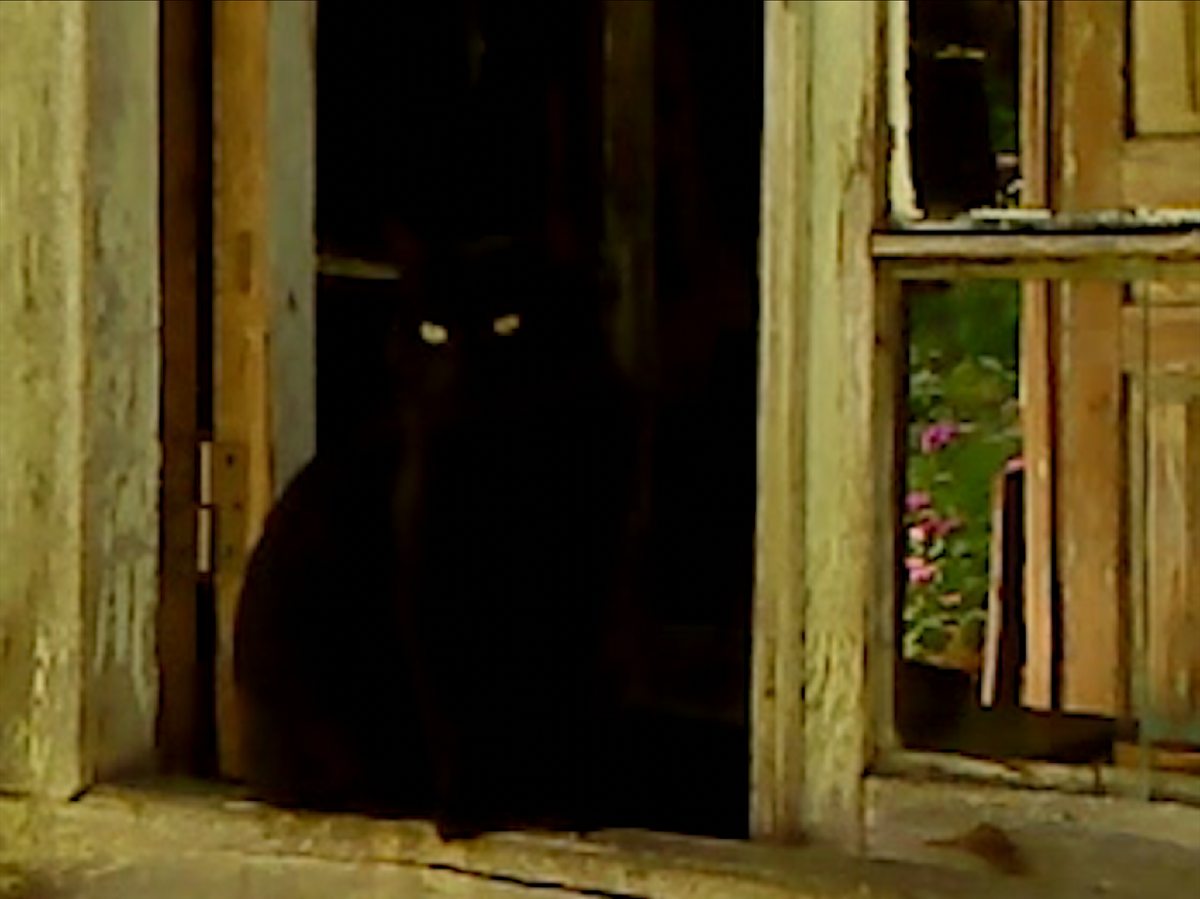
Irakli has learnt that his daughter Lisa has vanished. It arrives by letter, through a grapevine that already indicates technological scarcity. She wishes not to be found so he decides to do so anyway, teaming up with Levani, who for an added kick is invisible. Despite a plot that could pass as a twisty psychological thriller, this is all about audience subversion. Together, Irakli and Levani trace a quiet beeline across Georgia, the film’s Sony Ericsson camera capturing every football field, villager, tree in the breeze, cat and dog along the way. Lo-fi filmmakers eat your heart out.
No stranger to 144p cinema, Koberidze first experimented with the resolution and its Sony technology in 2017’s Let the Summer Never Come Again which also roams around the Georgian countryside albeit with more reverence for the interpersonal. For a hilarious trivial twist, that film actually beats Dry Leaf in duration. Any questioning of Koberidze’s sincerity for glacial adventures becomes hard to fault when you trace the lines of his commitment (to the bit). Whether he is making a gross gesture towards arthouse lovers is a common debate in post-film debriefs.
This is so close to the type of video art that you stroll past at museums, hands clasped behind your back in quiet appreciation or confusion, with a painterly texture that could be compared to the best of visual art — I see your Claude Monet comparisons and raise the pointillism of Seurat. A dizzying effect is created when the camera zooms on one subject and holds it (look for the cow) and the pixels fold in on each other until the picture is unidentifiable. We usually hold beautiful cinematography and sweeping vistas in tender regard. They are comfortable and familiar. Saying a film has great cinematography is the easiest get-out-of-jail-free pass. How will you handle it when it looks like this?
In another setting, whether through the Ericcson’s tiny monitor, or in a liminal passageway at an art gallery, or at home, Dry Leaf would not conjure up the same effect as it does in a cinema. It may just be the stillest film to elicit the most groans, rustles and bathroom breaks. And that’s intended as a compliment! It is catnip for those who crave a collective feeling from challenging cinema.
What plays out as a formal exercise where technology feeds story and vice versa also posits how we capture grief in our digital age, and how that is compressed beyond recognition. Here, reflection and humour are not guaranteed road-stops, not when the idea of never truly being known looms over the proceedings. It is one of the film's more shape-shifting enigmas to wonder if Lisa ever really existed. The illusion that Irakli is struggling to let go from feels interchangeable with a universal parental experience, from the common empty nest syndrome to the unfathomable loss of your child. These themes are at the forefront of filmmakers’ minds; it felt like 2025’s cup runneth over with stories of parents failing to connect with their children. Even at this year’s Sydney Film Festival, I felt like I was in a marathon of similar pieces that all built up to the same questions. As an aside, it was fascinating then to watch Sandra Wollner’s Everytime within the same 24-hour window (while being mindful that its plot developments should be safely guarded) and see how the two films communicated with each other in their stripped-back ways that cut through sentimentalism and nostalgia.
The forced gaze of the film, in what and who we see and don’t see, provides a bed of weight to the missing person tale and a growing disconnect between generations, the nature that surrounds us and each other. This is meditative and audacious filmmaking that transcends any limitations on endurance. For an added bonus, it may be the one film that panders to both cat and dog lovers — the latter appears so many times that it would have made the most serious Palme Dog contender in a long time had it premiered on the French Riviera. And how many films can say they do that?
Besides, how often do we get to sit with the luxury of repeated symbols in our saturated digital world where yearning for more pixels literally defines technological power and our relation to what makes the “best image”? The beauty is that this will anguish some and inject bliss for others. It is certainly tongue-in-cheek (perhaps unintentionally so) that Koberidze is toying with our attention spans via a phone that has rocketed its own development and has corrupted our own.
In our technology-fuelled present, where the camera that follows us in our pockets is both convenient and terrifying, Dry Leaf doesn’t just want you to look closely, it implores you to squint. What will you find in your every day when you do the same? It is filmmaking where boundaries and the audience are meant to be pushed and Koberidze has certainly created a new precedent — that is until someone makes a 96p movie…
Pick of the Week
- I kinda have to suggest Dry Leaf, which is on screening at Golden Age this upcoming Tuesday, the 29th. But this weekend Pink Flamingo's Lost Weekend fest has an incredible program of the most insane independent films from the past 30 years.
New Releases - THURSDAY 24th September
- Heart of the Beast (David Ayer)
- The Last Whale Singer (Reza Memari)
- Charlie Harper (Tom Dean, Mac Eldridge)
- Avengers: Endgame Encore (Russo Boys)
Want a weekly guide that tells you what's happening on Sydney screens? Subscribe (for free) to get hand-picked recommendations or follow the Fleapit on Instagram to see the highlights of each week!
Comments ()