
Father Mother Sister Brother by Jim Jarmusch (2025)
You can choose your friends, but you can’t choose your family...
Watched by Mitch Bozzetto
“You can choose your friends, but you can’t choose your family” is heard in Jim Jarmusch’s latest three-part dramedy, and it pretty much sums up the film’s central theme of fractured familial relationships. The rest of that old saying, “an’ they’re still kin to you no matter whether you acknowledge ‘em or not,” isn’t heard, but it hangs over everything, as we follow three separate stories of family life that differ in location and dynamic, yet all arrive at similar painful truths about the relationship between parents and their children. So much so that it leaves you to measure your own connection to the ones who made you.
The first story, ‘Father,’ is set in America and follows Jeff (Adam Driver) and his sister Emily (Mayim Bialik) on their way to visit their father (Tom Waits). We only see the tail end of the drive, but in that stretch, the distance between them becomes obvious. Their exchanges carry the stiffness of people who rarely keep in touch. Once inside their father’s house, that awkwardness only intensifies. This is a family that recognises each other without really knowing each other. Dialogue is delivered in short responses as the visit passes by with a polite sense of obligation. Jarmusch draws out the discomfort with added humour through mundane conversations about the quality of water, Rolex watches, and the phrase “Bob’s your uncle.” By the time Jeff and Emily leave, there’s a shared pretence that the visit could have lasted longer, though it’s clear everyone is relieved it’s over. It’s an insightful first act that sets the tone for what follows.
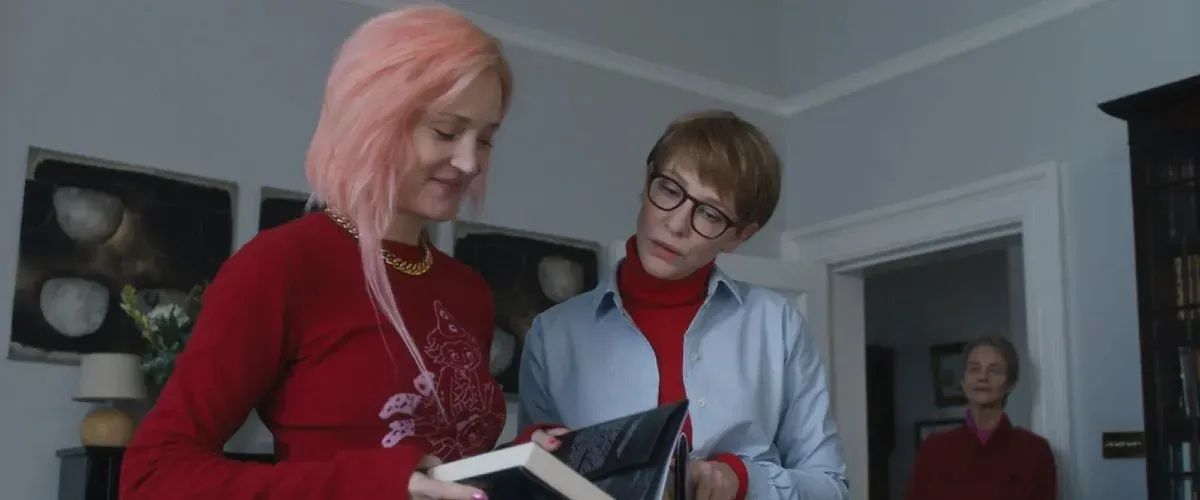
The second story, “Mother,” is set in Dublin and follows a wealthy mother (Charlotte Rampling) inviting her two daughters, Timothea (Cate Blanchett) and Lilith (Vicky Krieps), over for their annual high tea gathering. From the moment they’re together, it’s clear why these visits are only once a year. Like the first story, there’s an awkwardness to the interaction. It’s another authentic portrayal of a family that shares a history, but little sense of what’s actually happening in each other’s lives. It’s also where the film’s connective links begin to show. Details from the first story resurface: hot drinks, table settings, conversations about water, the phrase “Bob’s your uncle.” They’re small things, but they create a sense of familiarity between lives that otherwise feel worlds apart. Different country, different circumstances, yet the same habits and conversations reappear. It’s Jarmusch’s way of reminding us that even though every family is different, deep down, we’re all the same.
The final story, “Sister Brother,” takes place in Paris and is by far the film’s most moving. Sister Skye (Indya Moore) and twin brother Billy (Luka Sabbat) return to their late parents’ apartment to clear out what’s left behind. Unlike the earlier stories, there’s a strong bond between the siblings, which we can assume comes from this recent shared loss. As they reminisce over the leftover pieces of a life they’re still trying to understand, it leaves you thinking about how much we ever really know about our parents. Who were they before us, and who are they once we leave the nest? Jarmusch explores these universal truths in familiar ways that feel all too real.
We’ve seen countless stories about dysfunctional families on the big screen, but Jarmusch approaches the topic with a fresh lens that focuses predominantly on dialogue, or at times, a lack thereof. This stripped-back approach may deter some, but those willing to embrace it will find something deeply affecting, as it exposes the layers beneath these relationships. Jarmusch builds the film around difficult exchanges, but in a way that feels gentle and grounded. He has a knack for making the everyday feel provocative. We see it in the recurring slow-motion shots of skateboarders drifting through the start of each story, a little nod to youth and memory. We hear it in the uncomfortable silence in the middle of conversations; a reminder of how often families talk around things instead of through them. It’s these little things that leave the biggest impact, even if we don't realise it at first.
What, perhaps, is the film’s most effective move is how it shifts our perspective on parents by centring the first two stories around their presence, and the final story on their absence. By doing this, the parents from the earlier stories begin to feel more like fragile, aging people rather than difficult personalities. It makes you start to think that all the awkward silences and small talk are, in fact, fleeting opportunities for connection that won’t always be there. Jarmusch seems to suggest that maybe understanding who our parents truly are only begins once they’re no longer around to explain themselves or be misunderstood. It’s a profound thought, but an honest one, and as we’ve come to learn, Jarmusch has always had a way of revealing life’s biggest truths within its smallest moments.
Father Mother Sister Brother is about as understated as Jarmusch gets, and it results in one of his most real films to date, one that stays with you as a constant reminder to check in on your parents more often. On that note, I’m off to see mine.
Father Mother Sister Brother is in cinemas now.
Pick of the Week
On Wednesday (15 April) there is a very special chance to see a very special Australian film for free, along with a Q+A with the director. Clara Law's Floating Life marks 30 years this year and has remained a defining film for Asian-Australian cinema. The film screens at the Sydney Cinematheque.
New Releases - Thursday 9 April
- Undertone (Ian Tuason)
- The Deb (Rebel Wilson) AUS
- You, Me & Tuscany (Kat Coiro)
- Megadoc (Mike Figgis)
Looking for the weekly guide? It's relocated into the regular newsletter. Subscribe to get curated recommendations or follow the Fleapit on Instagram to see the highlights of each week!
Comments ()