
Gillian Armstrong & The Adelaide Three
No one can predict your future, especially yourself...
Watched by Matthew Donlan at the Ritz
One of the questions I dreaded answering the most in high school was “what do you want to be when you grow up?” Being told, often in the same breath, that I could be anything I wanted didn’t help narrow down the options. I’d often try to describe it more in terms of values. I wanted to be able to research topics that interested me, digest and analyse information and then communicate it to others in different modes. What form that took (teacher, academic, journalist, writer) was a secondary issue. A decade later from those questions and I like to think I’m achieving that in some way, albeit in an industry I didn’t expect to be in ten years ago, in a city I didn’t expect to be in.
When I turned twenty, I wrote a letter to myself, put it in a sealed envelope and wrote on the front ‘open when you turn 30’. I’m now closer to the day when I open that envelope than I am to when I wrote it. Through every move I’ve kept that envelope safe and wondered what was in it. I know, vaguely, what topics I discussed (work, life, relationships etc) but I’ve since forgotten the specifics.
Now consider yourself from ten years ago. Where were you? Who were your friends? What music, movies, people did you like? Ask that person if they’d expect to be where you are now. For most of us I’d expect the answer is no. Or at least, ‘maybe, but not quite like this.’
Our lives change and evolve drastically from what we expect when we’re younger. Inherent in this is a self-forgiveness. An understanding that things didn’t go the way you’d expect but that it’s okay. These things happen. But imagine if there had been some accountability mechanism. An objective outsider recording your response to that ‘where will you be in ten years’ question and checking in on you when the time came. That could be a confronting and frightening experience, or it could be enlightening and promising.
For Kerry, Josie and Diana, it was a mixture of both.
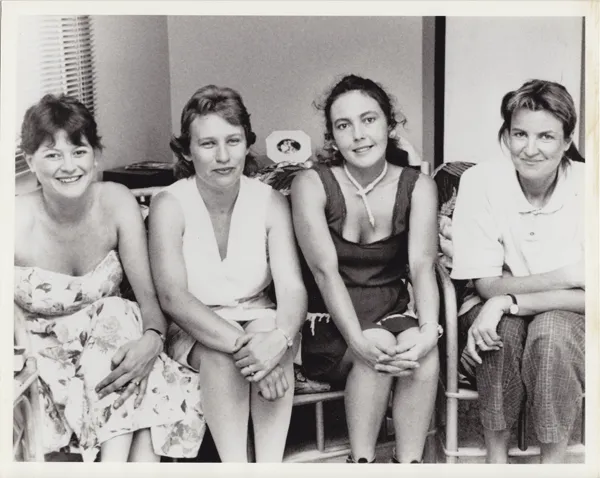
In 1976, Gillian Armstrong was commissioned by the South Australia Film Corporation to produce a short documentary, Smokes & Lollies, on teenage life in Adelaide. Researching for the film, Armstrong was shocked to find three girls, aged 13 and 14, whose only desire was to be married with children on the way by the age of 18. These three friends, Kerry, Josie and Diana, dubbed ‘The Adelaide Three’, became the focus of what grew into a decades-spanning documentary series.
Four years after Smokes & Lollies, Gillian returned to the three girls, now 18, for Fourteen’s Good, Eighteen’s Better (1980). Then returned again eight years later for Bingo, Bridesmaids & Braces (1988). And again, for Not Fourteen Again in 1996, and one final time in 2009 for Love, Lust & Lies.
The first, third and final films in this series were screened at the Antenna Documentary Festival to mark the 50th anniversary of Smokes & Lollies, followed by a Q+A with Gillian Armstrong, Kerry, Josie and Diana’s daughter, Aimee.
Across this series you are granted a radically honest insight into the heartbreaking hardships and joyous highs of adolescence, single motherhood, suburban Australia and changing attitudes of a woman’s place in the world. Marriage, virginity and motherhood are themes which cloud over the earliest film. They are discussed with such certainty and confidence by the young girls, only for us, and them, to see the reality of those complex ideas unfold in actuality years later.
This honesty and intimate insight into their lives is only afforded due to the care and respect shown by Armstrong throughout. Her desire was to make a documentary that gave its subjects their own voice, a radical idea for Australian documentary-making at the time. Giving the girls this autonomy to say whatever they wanted created an environment in which hard-hitting truths were shared with ease.
The most striking is perhaps Josie’s nonchalant description of life as a single mother, unsupported by her family. While enduring a 24-hour labour in the hospital, Josie’s family rarely visited. She explains later that, while at the hospital, she arranged for flowers to be sent to herself because everyone else had flowers and she didn’t want to be left out. She goes on to say that now, in her home, the only sounds she hears are the ticking of the clock and the crying of the baby. How these sounds meld together and distort her perception of time and space. Days collapse into weeks as boredom takes hold. It is a display of immense resilience shielding years of pain.
By the time we reach the women in their late 40s in the final film, there is an air of familiarity, like returning home to see old friends. It’s as if, by this point, we know them so well. But we’re reminded that these films are only a snippet of their lives as they share more hardships and secrets with Armstrong. It is a poignant reminder that you can never fully control what will happen to your life, but that you persevere every day. To make the most of it. To build a family, by blood or by choice. To forgive but never forget.
Antenna Documentary Film Festival continues until 15 February 2026.
Pick of the Week
This week I encourage you to buy a ticket to Cineflux and enjoy a night of short films. All Sydney-based filmmakers, this is a chance to celebrate independent filmmaking. Details available here.
Just Dropped
The Art Gallery of NSW launched its Sydney Cinémathèque programme and it is stellar. Kicking off in March, the Gallery will be screening an incredible range of Sydney-based films with friends from the city's film community. Most screenings are free so get in early!
You Might Have Missed This...
 Helena Williams
New Releases: Thursday 12 Feb.
- "Wuthering Heights" (Emerald Fennell)
- Crime 101 (Bart Layton)
- Whistle (Corin Hardy)
Looking for the weekly guide? It's relocated into the regular newsletter. Subscribe to get curated recommendations or follow the Fleapit on Instagram to see the highlights of each week!
Comments ()