
Hamnet by Chloé Zhao (2025)
To watch or not to watch, that is the question...
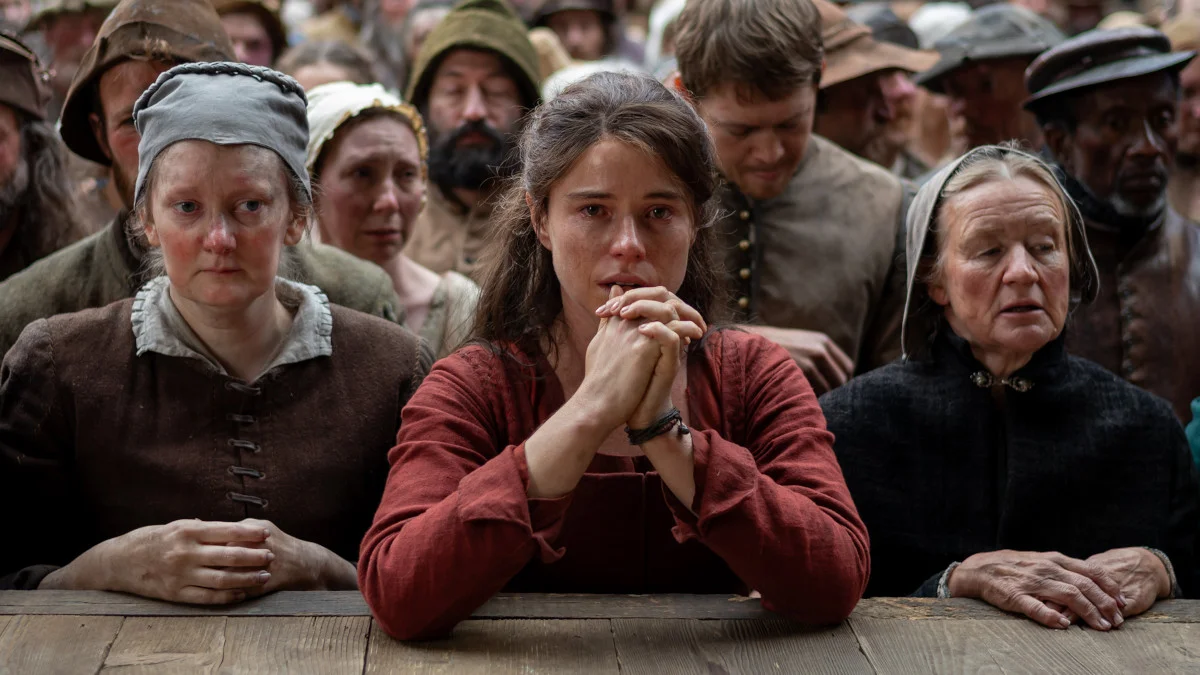
Watched by Matthew Donlan at Palace Cinemas
Hamnet opens with a card explaining that the names 'Hamnet' and 'Hamlet' were interchangeable during Shakespeare's time. From this one fact the film argues that the playwright's most famous tragedy was directly drawn from the grief of losing his only son at a young age. It is a precarious thread to draw, one designed for maximum emotional devastation, and one which grew tiring, predictable and ineffective.
Chloé Zhao's latest endeavour, Hamnet, adapts the 2020 Maggie O'Farrell novel of the same name with Paul Mescal as Will (William Shakespeare) and Jessie Buckley as Agnes (Anne Hathaway). Agnes is an oddity of the town, rumoured to be the daughter of a forest witch, she uses herbal remedies to cure ailments and can supposedly read someone's future just by holding their hand. Shakespeare is a learned man who teaches Latin to several students but suffers under his father's pressure to take up a safe job in manual labour. From the moment the two meet it is clear there is a destiny tying them together.
Years later, with William in London pursuing theatre, Agnes is left in the country to care for their eldest daughter Susanna, and their twins Judith and Hamnet. But when the plague tragically cuts short Hamnet's life, their relationship is strained even further, with William rushing back to London to put on a performance of Hamlet at the Globe Theatre.
This film struggles under the weight of its own importance. Hamlet is perhaps the most famous play of Shakespeare's, having countless adaptations and parodies and its language seeping into our everyday vernacular. Each of us have already had some point of contact with the play before this film. So the question is, what is gained from a fictional retelling of the play's origin? It is a risk to blur the true tragedy of Hamnet with the fictional play and one which doesn't pay off.
The inherent tension here is the use of historical fiction as a genre against such a notable figure. While a common criticism for many works of historical fiction, it feels particularly warranted here given the use of Shakespeare. By centring the story on one of the most influential, studied and adapted figures in British history, the film uses its position of power to present an alternate truth to his life. It is somewhat reckless to normalise this narrative and undermine the work of historians in such a manner. The film simplifies much of Shakespeare’s life, condenses the timeline of events and cherry-picks moments to service its own goal.
The film feels mechanically engineered to make the audience cry. It is steeped in a morbid fate as we shuffle closer to its climactic moment. It pursues an emotional response to the nth degree with Richter's score, precisely staggered dramatic set pieces and a self-referential script. It does not trust the audience to piece it together themselves, instead opting for a hand-holding experience to coax tears. Flashbacks and dreamy visions undermine any subtlety in dialogue by putting to picture an exactness of what's to come or what has just been. The deployment of the infamous 'to be or not to be' not once by twice in twenty minutes is overly cheesy and tragically predictable. And the re-using of Richter's iconic 'On the Nature of Daylight' simply conjures images from other iconic films. Each facet feels like an insecurity. As if the film does not believe that it can achieve an emotional payoff without relying on prior external knowledge and references.
Buckley's performance of Agnes is perhaps one of the few redeeming qualities of this film. She demonstrates her exceptional range and strikes the right balance between mystical and grounded. Yet, even then, I found her most dramatic moments, despite being delivered with full emotional force, moved me little. The only other stand out performances come from the real-life brothers Jacopi and Noah Jupe who portray Hamnet and Hamlet respectively. Their innocence and earnestness come through in their performances, gripping you in their beautiful delivery. Mescal, on the other hand, disappointingly feels out of place in this world. Wearing his emotions outwardly feels forced and as the film shifts focus to him in the third act, any subtlety that remained in his character disappears.
If, in its first half, the film’s weakness is the blurring of fact and fiction, in the latter half it is the blurring of central characters. For much of the runtime, Hamnet centres on Agnes, her home life, her struggle to fit in, her motherhood, and her grief. This section is perhaps one of the stronger elements of the film as it paints an interesting exploration of motherhood and femininity in old England. It sets up the potential for a strong conclusion on the troubles and hardship women suffer in the shadow of ‘brilliant’ men. But, this is abandoned in the third act to shift focus to the male perspective of Shakespeare in an attempt to make a statement on the healing power of creating art. That sentiment would perhaps be stronger if we witnessed its restoration on the creator of said art, William, not on the spectator, Agnes. We spend so little time with Shakespeare in the preceding hour so as he weeps in the wings of the stage we feel very little. For Agnes, it's not a cathartic moment of creative release, but a discovery that her husband was in fact grieving the loss of their son in a method different to her. This final message feels messy from a narrative standpoint but makes sense if you consider that every decision in the making of this film was based on maximising the waterworks.
Hamnet is screening now in most cinemas.
Pick of the Week
Last weekend marked the one year anniversary of David Lynch's passing. A singular artist across his lifetime, perhaps his magnum opus was Twin Peaks: The Return. To remember the great filmmaker, the Ritz will be screening all 18 episodes across two days (24-25 January). Details and tickets here.
Just Dropped
The Mardi Gras Film Festival, running 12-26 February, has released its full programme. Alongside opening film, Jimpa, are Pillion (starring Alexander Skarsgård), The Chronology of Water (directed by Kristen Stewart), a live commentary of Lesbian Space Princess and plenty more.
New Releases: Thursday 22 January
- The Secret Agent (Kleber Mendonça Filho)
- Marty Supreme (Josh Safdie)
- Primate (Johannes Roberts)
Looking for the weekly guide? It's relocated into the regular newsletter. Subscribe to get curated recommendations or follow the Fleapit on Instagram to see the highlights of each week!

Comments ()