Interview: James Robert Woods and The Birthday Trip
The local director on the Australian film industry, building a script and casting Luke Jacobz...
Conducted by Matthew Donlan
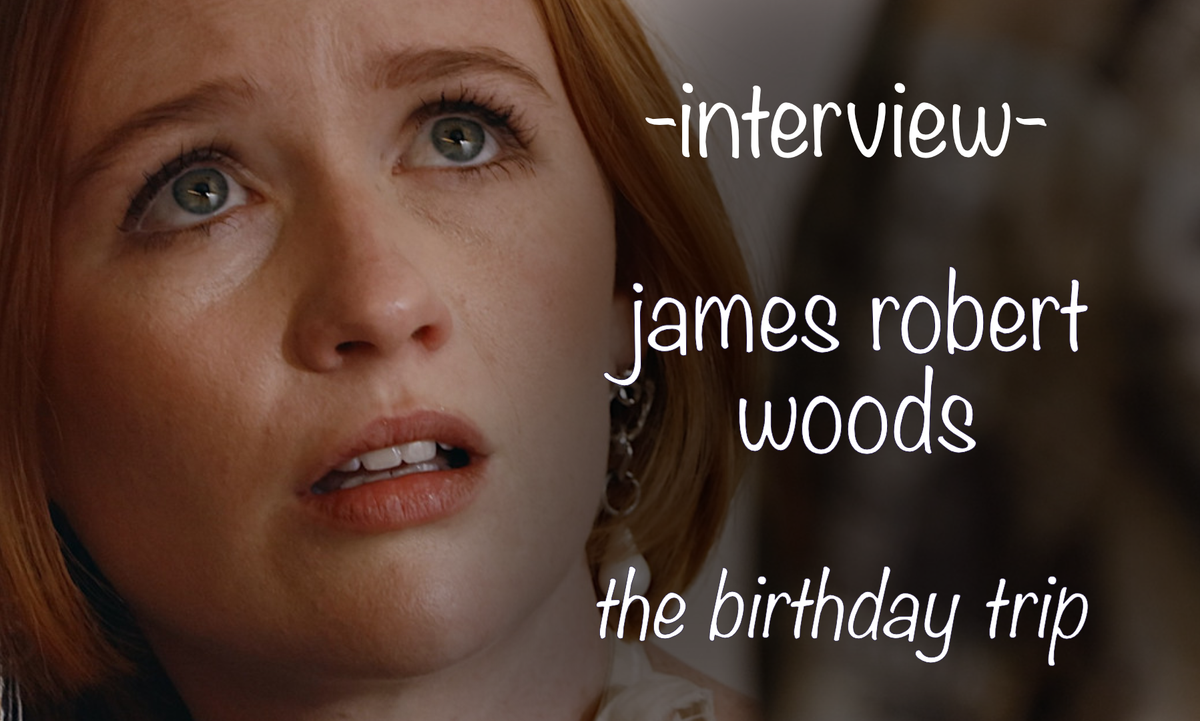
The Birthday Trip, directed by James Robert Woods, is an acerbic and brilliant contemporary Australian satire. With an excellent ensemble of Aussie actors, the film pillories colonialism, class divides and the local arts scene. It's energetic, funny and all-too-real. The film screens with a Q+A tomorrow (Thursday 25 June) at the Hayden Orpheum, and releases in cinemas in July. I had the pleasure of sitting down with James to chat about the Australian film industry, and the film itself.
Thank you to James for giving his time and words.
James, thank you for chatting. I’d like to begin with your production company, Badlands. It is focused on auteur-driven works. It feels rare in Australia to find auteur work. What draws you to this?
Film as a medium is so specific. It's such a unique and magical confluence of different disciplines and artistic practices. For a film to be engaging emotionally and to push culture forward in an interesting way, I think it needs to have an authorial voice. And that's not to say that there can't be a high-level collaboration with HODs and these amazing creatives, but I do think there needs to be a singular thrust to it. In an Australian context, it's frowned upon a little bit. In the mainstream funding pipeline, there's certainly more of a preference for collectivised storytelling.
I think in an Australian context, the idea of the auteur is certainly frowned upon, and at Badlands, that's been one of our main building blocks. Whether it's one of Steph’s projects, one of my projects or hopefully in the future projects with other creatives, it must have that singular vision.
And while there's still collaboration and lots of great people involved, it always comes back to the idiosyncrasies of the human being. You see companies or studios pushing technology that drowns out the idiosyncrasies of an artistic voice but that's what's beautiful about the cinema.
From your perspective, are you feeling a rise or fall in the Australian film industry in terms of auteur/underground works?
In Sydney specifically it feels like in the last couple of years, the film culture has really ballooned. There are new festivals, new screening spaces, there are people making weird, wonderful, wacky work. Maybe that's confirmation bias and I'm just seeing it more or maybe that is a response to the kind of more homogenised, government pipeline of films.
Government funding of films is very important, but I think the way it manifests in Australia, given our population size and maybe tendency for cultural cringe and tall poppy syndrome, I think that does result in a certain type of film that doesn't necessarily connect.
There's a certain type of Australian film, that fewer than 5% of people are going to see Australian films. Yet 50 million people a year buy tickets to the cinema. So that's broken. Like there's a total disconnect there. I do think there's a disconnect because there's a lot of incredible, amazing authorial filmmakers with loud, brash voices, in this country. And there's obviously a giant market of 55 million ticket buyers who want to see good stuff. And they're not connected; they're totally missing each other.
Turning to The Birthday Trip, the film tackles a few themes with a contemporary lens; colonialism, class commentary, the lack of cultural arbiters in Australia, the crab bucket mentality…
The crab bucket?
Oh, so if you put crabs in a bucket, they will climb on top of each other and pull each other down, so they never get out of the bucket. As soon as one gets too high, they just grab them but if they worked together, they could build a ladder to get out.
That's so interesting, that’s such a great metaphor. Sorry, I interrupted your question…
No all good, so these themes in the film, they all feel like a symptom of things. I was wondering what you were responding to in Australia when developing the story?
My starting point was characters. I wasn't thinking in a grand ideological sense. Initially it was who are these characters? Who do I want to render? What experiences or emotions have I had that I want to see on the screen?
That was the first port of call. And then it was, I have all this material that's built up over many years. What's the structure? The weekend away. The kind of pragmatic, structural concerns of making this a thing that can exist in a narratively sensible way. But by placing these characters on different areas of the ideological spectrum, the jobs market and cultural landscape, they all became vehicles for cultural commentary, criticism and satire. And some of that was just because it was fun to write.
And then when the story started to come into shape, three privileged couples who go to this bougie farm stay, I want them to be confronted with the weight of that privilege and what that privilege means in the context of modern Australia. They all play a role in turning the wheel of the capitalist colonial project. They’re holidaying on stolen land.
We can't pretend we live in a utopia. We still have class hierarchies and racial hierarchies and unresolved colonial wounds. So, they need to all be in there, because otherwise, I'm not writing something that's real.
How clear were the dynamics between the characters and their relationships from the start?
Pretty early on. I wanted to explore relationships that were dysfunctional, imperfect, maybe in some cases had overstayed their welcome. Because I've been at that dinner party where there's a couple and it's like, “oh, why are they together?” I thought that was interesting. Exploring couples who have quite specific forms of dysfunction.
So that was all there from the start. I wanted the couples to not be perfect because that's fun. But then as far as throwing them all together, I guess I was trying to find a crab bucket, to use the recently learned metaphor, in which they could all interact.
Along with the carefully written script, it is paired with the handheld camera work. I was curious about the decision to go handheld and at what point did that come to you in the development and production?
Handheld has been my style for a while. I've made a few short films that have had similar, handheld reality style camera. It’s the most immersive way to shoot something, in my opinion, and to feel the voice of the author in the scene.
It’s important to have a human responding to the action quite viscerally in the moment. You can feel that with every rack focus, every pan to this instead of that. It's a very loud personal preference, and it facilitates greater immersion in their verisimilitude.
In screen storytelling you do get hyper focused on technology. The $50,000 camera package but if the script and the acting is bad, that stuff is irrelevant.
I think it's interesting you mentioned that because there's this one shot right towards the end of the film, where the camera tracks a character and then you see the camera come off the shoulder and look to the ground before switching off.
That's the perfect example. On the page that was just a bunch of goodbyes. No subtext, no nothing and I never knew how to shoot it. That blockage stayed up until we were shooting it, and then I was like “it has to be a one-r.” This should be a lyrical end to the film.
So, we blocked it out for the one-r and I think the one in the film is the third take. It was the last day having all the cast together, so the confluence of it being a literal goodbye of the assembled cast, it being the last moment of the characters in the film, and this moment of movie magic, it made it really emotional. When I was walking away, I just put the camera down and buttoned off and was very emotional in that moment. And that's why I kept it.
That moment, along with the painting scene provide these moments of breaths for the audience. The one that stuck with me is when the group are stargazing and discuss the Wow! signal. How did you find those breaths in the script and filming?
It wasn’t front of mind when I was writing it. But those two scenes do fall at the transition between the acts so I think on a cellular level or a rhythmic level, I knew that there needed to be a comedown after a lot of social anxiety and crazy dialogue.
As far as finding it on the day, the painting scene was performance wise, quite easy, in that they were literally painting in the field, not for the crew though because of the rotating camera approach we were trying to perfect.
But the stargazing moment, that was our second last night, and so it provided a capstone on those six characters in a really nice way. Because we shot it chronologically, you can feel the group congealing and becoming more familiar.
Was it deliberate to shoot chronological?
Yes, for performance, I knew that I wanted to try and mirror the core of the story to try and foster that same social anxiety and work schedule. Like I was saying before you can feel them becoming stronger as a group and bonding more. And that was happening off screen as much as on.
On the actors, it’s an incredible ensemble. I feel like every person is cast perfectly for their roles. I know you’ve worked with some of the cast before, what was it like pulling the team together?
Ben's role (Ben Gerrard as Mark), and Josephine (Starte) playing Angie were written specifically for those actors. David Quirk’s (as Jim) kind of was. In many ways he’s my self-insert for when I just want to have an opinion, it's usually coming out of neurotic Jim. But I had that relationship with David, and we share a sensibility and the way he naturalises wordy dialogue is just stunning.
Sapphire Blossom, as Sapphire Phoenix, I just wrote the Sapphire that I knew and had seen.
So, half the cast were cast very early on, at least in my brain. I had always envisioned Luke (Jacobz) but he’s a famous TV host, so I thought it wouldn’t be realistic that he’d be interested in doing it, but we went to his agent and he liked the material.
Robert (Preston) and Nicola (Frew) were both cast very late. We really struggled to find the right actor for Felix since he’s the moral core of the film and is positioned as the voice of the audience. To find someone who had the nuance and the emotional engagement to play that role, but also the ability to flip that and go to a catastrophic place was really hard to find.
And for Nicola, we auditioned 20 actors for that role, really great actors as well, but we struggled to find someone who felt like they were fighting for their life and Nicola had that intensity.
So my final question. We’ve talked about the Australian film industry and ecosystem. I like to ask people what are the under-appreciated gems that more people should be talking about?
What a great question.
My first thought is Strange Colours (by Alena Lodkina). That’s one of my favourite Australian films. It's an incredible, unique authorial, immersive visual work.
I feel like everyone's on the Adam Briggs train. A Grand Mockery (co-directed with Sam Dixon) is a unique feat of Aussie filmmaking. I admire the way he keeps making films. It's obviously paying off, and I think his engagement is amazing. We did a Q&A with him up in Brisbane and his characters from his films were just there hanging out. This is not a film; this is something real.
And the other shout out I'll give is to Stephanie Jane Day, the other half of Badlands. She's working on a film called Slowness. That doesn't exist yet, but it will. Can I give a future shout out to an arthouse film that will exist?
Absolutely.
Then those would be my three.
Thank you James for your time.
The Birthday Trip screens at the Hayden Orpheum on Thursday (25 June) with a Q+A hosted by Rob Carlton. The film releases in cinemas in July.
Pick of the Week
I really recommend you go see The Birthday Trip. It's an incredibly funny, satirical and well-constructed Aussie film that is being independently distributed.
New Releases - Thursday 25 June
- Supergirl (Craig Gillespie)
- Minions & Monsters (Pierre Coffin)
- Glenrothan (Brian Cox)
- NT Live: The Playboy of the Western World (John Millington Synge)
Looking for the weekly guide? It's relocated into the regular newsletter. Subscribe to get curated recommendations or follow the Fleapit on Instagram to see the highlights of each week!
Comments ()