
Iron Winter by Kasimir Burgess (2025)
An ancient tradition goes on the move in Mongolia...
Watched by Cristian Speranza
This review follows a Q&A Cristian hosted with director Kasmir Burgess and producer Morgan Wright for Antenna Documentary Film Festival.
Historically, as winter beckons in Mongolia’s Tsaikhir Valley - where temperatures can reach as low as -50°C - hundreds of horses owned by the area’s nomadic inhabitants are herded and guided across the valley in search of greener pastures, so as not to strain the fertile land relied upon by their owners during this inhospitable season. As climate change threatened the delicate balance of this eco-system, with droughts further reducing the amount of fertile land, the practice was abandoned in 2018.
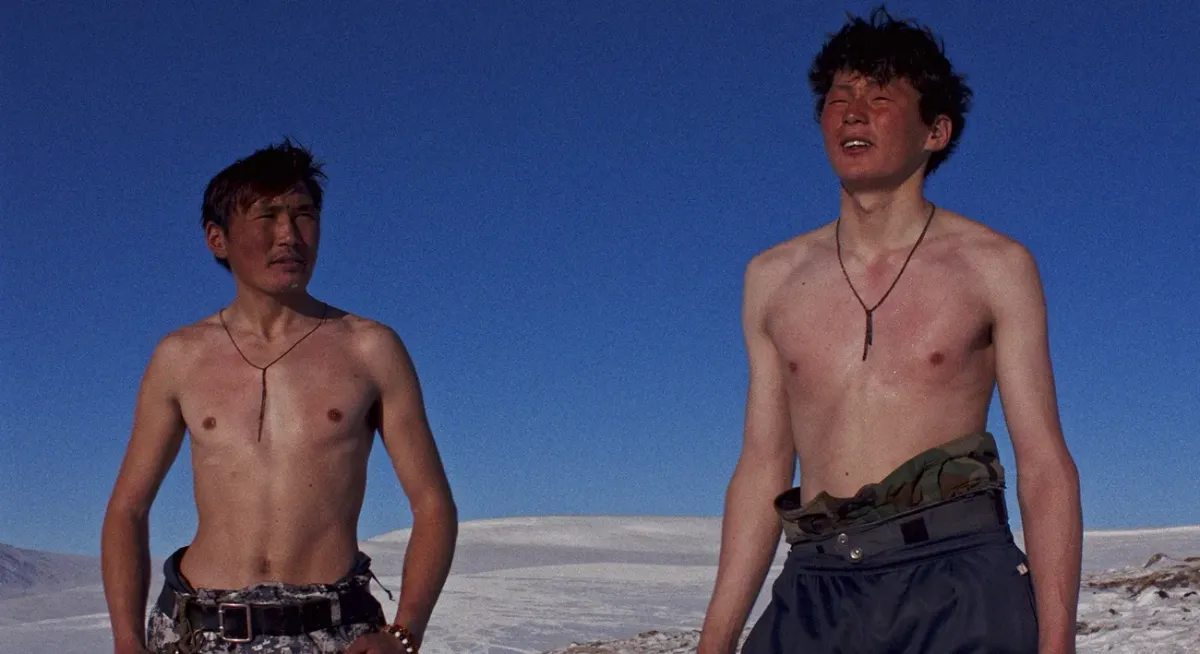
Iron Winter documents Australian director Kasimir Burgess’ attempts (alongside a daring Mongolian/Australian crew) to capture the community’s revival of this ancient tradition through the eyes of Batbold, son of one of the few remaining herders, Bayankhangai, an 18-year-old boy making the journey for the very first time.
We are first introduced to Batbold by way of homage. In a Fordian-styled sequence he is framed against his village, perched high above it, the horizon an overlap of expansive plains and soon-to-be snowcapped mountain. We then reverse, now in close-up, Batbold’s youthful face is captured against the treacherous terrain behind it, his brow furrowed with determination. Finally, we approach a gate, creaking as it swings in the wind, revealing Batbold’s family yurt. Like those westerns of old, this introduction invokes a sense of trepidatious adventure, the promise of untamed lands beckoning exploration, promising the traditional ‘hero’s journey’. The stakes are laid bare, Batbold’s world hangs in a delicate balance. Threatened on all sides by an inhospitable terrain, he must depart to save them and, in turn, discover himself.
That is not to say that the film is dour, far from it in fact. Batbold’s family is delightful; his mother is endlessly doting, his father a ruffian-workhorse (pun intended) with a heart of gold, both of whom fawn over their baby daughter. At one point, we see Batbold staring curiously, perhaps longingly, at a television program showcasing the Mongolian capital city of Ulaanbaatar, and here a seed is planted. The young Batbold is torn between his village life, his family and tradition, and the city, which represents opportunity, prosperity, a modern existence for the young man. His physical journey thus transforms into a spiritual one.
Before Batbold and his companion Tsangana, 22, can depart, they engage in prayer before a stone monument just outside the village. Ominous music swells as Batbold peers through a glass perforation in the stone, revealing the incredibly well-preserved corpse of a Tibetan-Buddhist monk. Here, Burgess’ observational style avoids over-explanation, favouring instead an air of mystery. These traditions remain impenetrable to a general western audience, their significance, however, does not. Like the herding practices, there is a sense of modern ‘obsoletion’, especially when the harsh conditions of their existence are framed against the allure of city living. Here Burgess invokes the inevitable; the impacts of climate change on centuries-old native land practices, particularly those who bear the brunt of its wrath.
The herders’ journey across the Tsaikhir Valley is nothing short of remarkable, as they face blizzards, fight off wolves, and bury the frozen bodies of their herd, with Burgess and his crew deploying all manner of drone footage and sweeping panoramic wides to capture the epic scale of the young men’s undertaking. At the same time, however, they capture beautiful moments of buoyant intimacy between Batbold and Tsangana as they play-wrestle, practice picking up their uurgas (lasso on a pole) from horseback, and lament their disconnection from social media. These brief moments offer an incredible characterisation of the traveling companions, reminding us that they are hardly men, coming of age under the most inhospitable circumstances, yet still exuding infectious optimism, a radical optimism that is perhaps crucial, in Burgess’ eyes, in the fight for climate survival.
Likewise, the relationship between Batbold and his father, Bayankhangai, unfurls through intimate moments that, in my Q&A with Burgess, I jokingly demanded his guarantee that they were not scripted. One poignant moment includes Bayankhangai heaping joyous praise onto his son for taking on the family tradition and extolling his pride in Batbold’s herding abilities whilst lamenting his own ailing body, only for Batbold to conclude the conversation by professing his desire to move to the city. From this moment, the journey, and the relationship between Batbold and Tsangana takes on a fleeting tone, one that evokes the last days of summer break, but for two boys-becoming-men on the edge of the world.
In speaking with Burgess, he likened his crew’s undertaking to that experienced by Werner Herzog and his crew during the filming of Fitzcarraldo (1982). That this layer exists underneath the finished product and yet never disrupts its verisimilitude is refreshing in the face of an era of personality-driven documentary filmmaking. Instead, Iron Winter, in centering its protagonists, foregoes colonial questions of ‘why’ this practice should continue, and instead argues ‘it must’, inviting its audience to divert their focus to solving ‘how’.
Iron Winter screens in cinemas from Thursday (19 March).
Pick of the Week
This week I'm recommending you see Floodland. This is an intimate and moving Australian documentary about the devastating 2022 Lismore floods and how a community reckons with the aftermath. With so much going on in the world, climate change has fallen from our minds, but this doco reminds us its ever-present and will only get worse. You can see it at Golden Age here.
New Releases - Thursday 19 March
- Proclivitas (Miley Tunnecliffe) AUS
- Iron Winter (Kasimir Burgess) AUS
- We Are Jeni (Mariel Thomas, Akhim Dev) AUS
- La Grazia (Paolo Sorrentino)
- Project Hail Mary (Phil Lord, Christopher Miller)
- Ready or Not 2: Here I Come (Bettinelli-Olpin & Gillett)
Looking for the weekly guide? It's relocated into the regular newsletter. Subscribe to get curated recommendations or follow the Fleapit on Instagram to see the highlights of each week!
Comments ()