
on Muriel's Wedding and Lobotomy Chic
on this and that, #1 November 2026

on this and that, #1 November 2026
Despite bordering on being a mildly upsetting watch, Muriel’s Wedding holds a special place in many an Aussie heart. However, upon rewatch, I found myself shocked (clickbait quota reached) and then shocked at myself for being shocked (clickbait quota exceeded 😏).
What was it that shocked me so?
The complete and utter LACK of apathy from almost every woman, with maybe the exception of the mother in the first half of the film but trust we will be delving into that (apologies if that was an anticlimactic conclusion, but bear with me for the English Teacher level reach I’m about to make). Although a wild comparison, it occurred to me that one could argue our online personas are equally as stylised and curated as those of a film character; they are just dangerously better at disguising themselves as reality rather than an alternative to it. With the rising popularity of cultivated indifference and “numb cool girl” online personas (see Rachel Sennott saying ‘numb is in’), I couldn’t help but be taken aback by the outrageous responses from the Porpoise-Spittians and then taken aback by my own conditioned response to them.
For those who aren’t chronically online, lobotomy chic is the latest take on dissociative feminism. According to Aesthetics Wiki (real), lobotomy chic “is an aesthetic that focuses on exploring femininity through meta-irony, detachment and nihilism” and is mostly used by teenage girls who feel empowered by detaching from reality and acting apathetic and mysterious. This majorly contrasts with the world of Muriel’s Wedding, where the Ocker-influenced style and tone lend themselves to hyper-stylised characterisations of the cast, translating to extremely expressive (primarily female) personalities on screen.
Content creator Zara McIntosh articulates brilliantly how, in 2026, the commodification of numbness as an aesthetic is, theoretically, in retaliation to the nice-girl-you-should-smile-more patriarchal idealism of womanhood and offers a refreshing (I guess?) alternative. It says, “Fed up with the status quo? That’s ok, because you can simply opt out of feeling altogether”. As McIntosh progresses to outline in the video, this is concerning for several reasons, least of all that cultivated indifference maintains and upholds the status quo.
To pit ‘cool popular girl’ against ‘cool popular girl’ (fight to the death!), I want to start with Tania (Sophie Lee). Tania, to most, is immediately recognisable as the popular bitchy girl archetype with her blonde hair, done-up face and genuinely HEINOUS personality (or lack thereof). Where she differs from today’s most popular girl in school, however, is in her behaviour, specifically her reactiveness. Perhaps most notably, when she finds out her friend Nicole has been having an affair with her husband, and mid-Rhonda and Muriel ABBA performance, she launches at Nicole and starts physically attacking her. Say what you will, but in no world has she decided to make ‘numb and indifferent’ her personal brand.
How shocking that was for me to see (I may be exaggerating a little bit) perhaps speaks volumes on my screen time, or on the little dopamine demon I fight when I get the sudden urge to search up Instagram on my fucking DuckDuckGo browser. Although lobotomy chic is a smaller subculture of various trends, it’s infected more of our day-to-day than you’d think or can be seen as a byproduct of the amalgamation of recurring online trends we are seeing in 2026. Albeit more subtle, I would argue that the I don’t give a fuck attitude we see in the branding of big names like Charli XCX, alongside the rising rates of Botox (preventing physical facial expressions), as well as being in the midst of an Ozempidemic (underfuelled = numb, dissociated), and oop, all of a sudden, lobotomy chic doesn’t feel so underground or outlandish.
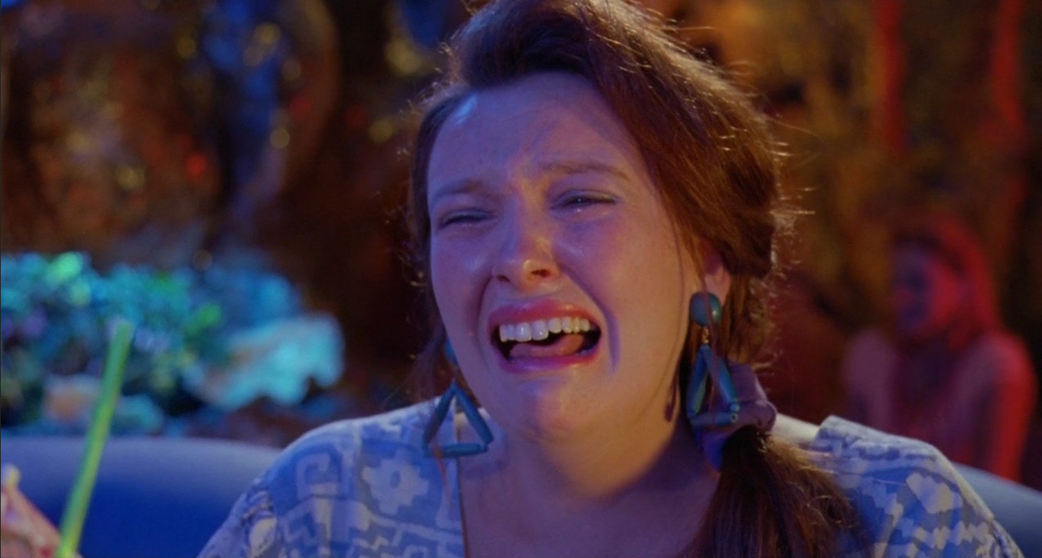
(image ref: you and your baby botox could never ugly cry like my girl Muriel)
Although I respect that obviously things in films are often exaggerated; Lobotomy Chic has led to the resurgence and glorification of films and television like Girl, Interrupted (1999), The Virgin Suicides (1999), and Daria (1997), all having come out of the same decade as Muriel’s Wedding. The internet is crawling with young girls glamourising media content featuring indifferent female protagonists. The youths’ algorithms (which they can now switch off #slay) are crawling with edits of Virgin Suicides to Lana Del Rey. To that I say: WHERE IS MY GIRL MURIEL. Where are the edits of a lovely dance montage sequence of Rhonda and Muriel to, oh, I don’t know, ABBA perhaps?
With consultation from the sacred online source, formally known as Reddit, a lot of the Muriel’s Wedding discussion thread revolved around the film’s darker undertone, often in relation to Muriel’s mother, with one of the first posts to come up being:
Muriel’s Wedding is actually a psychological drama masquerading as a romantic comedy.
In these sorts of discussions, a lot of people commented on Muriel’s mother, Betty Heslop, who, in the first half of the film, is apathy embodied. Lifeless behind the eyes, she is berated by her family in almost every scene; a punching bag. She has chosen to dissociate from the world around her to survive. In saying that, numbness, apathy and dissociation (core traits of the lobotomy chic) can often be the result of mental health conditions, medication, or neurodivergence. But what happens to those who can’t choose whether they opt in or out when numbness is no longer trending?
In Betty’s case, I would argue her dissociative feminism gives her a sense of autonomy over her own survival in the space in which she is forced to exist. Contrarily, in the video essay (not sponsored, just really good), McIntosh speaks on rage as being one of the only emotions that completely rejects feminine ideals. So when Betty Heslop sets the backyard on fire is she opting for an alternative route to her own autonomy, trading apathy for rage. I think it’s worth noting that rage, as an empowerment tool, is not afforded to all women in the same way and that apathy as a survival tool, whether utilised as a side effect or an active antidote to systemic discrimination, ethically can’t be conflated with aestheticised lobotomy chic.
So, all in all, I would argue the fetishising of dissociation, apathy and numbness in its peak commodified state lobotomy chic, is not perhaps the cuntiest (or useful) thing we could be doing for our equal rights movement.
imo.
It’s rather counterintuitive.
😀
There was always something that stuck with me about the scene where the mother sets fire to the backyard, or rather, when we hear about it. We never even see her post-rage transformation; she just disappears. She opts out. It serves to remind us that we all have choices; we all have the power to wreak havoc with the sliver of agency we have left, and if you have more than a sliver, well, get angry mama. I’m almost certain that my readers are those withOUT trendy lobotomy chic aspirations; however, dissociating from the world around us to cope with unimaginable things is, stab in the dark here, a lot more common.
The women in Muriel’s Wedding embody and are provoked by everything that happens to them; they speak their truth and they ugly cry. They watch each other fuck each other’s husbands and pull each other’s hair. It’s uncomfy and cringy and lame and everything you’d be in your worst online nightmare, but it serves as a testament to reactivity and rage as retaliation; something, as supersexycool as it might seem, numbness will never give us.
Pick of the Week
- You can see You Can See Everything everywhere, early. Wednesday 11 November provides your first chance to see the epic documentary. Tickets available for sessions at the Hayden Orpheum, Ritz, Dendy and Palace.
New Releases - THURSDAY 5 November
- Wild Horse Nine (Martin McDonagh)
- Wicker (Alex Huston Fischer, Eleanor Wilson)
- Godzilla Minus Zero (Takashi Yamazaki)
Want a weekly guide that tells you what's happening on Sydney screens? Subscribe (for free) to get hand-picked recommendations or follow the Fleapit on Instagram to see the highlights of each week!

Comments ()