
on Picnic at Hanging Rock and colonial Australia
on this and that #2 Mar, 2026
on this and that #2 Mar, 2026
My first introduction to Picnic at Hanging Rock was a beautiful hardcover book my mum bought for me as a child, and I, like many Australians, was immediately intrigued by the oh so mysterious happenings.
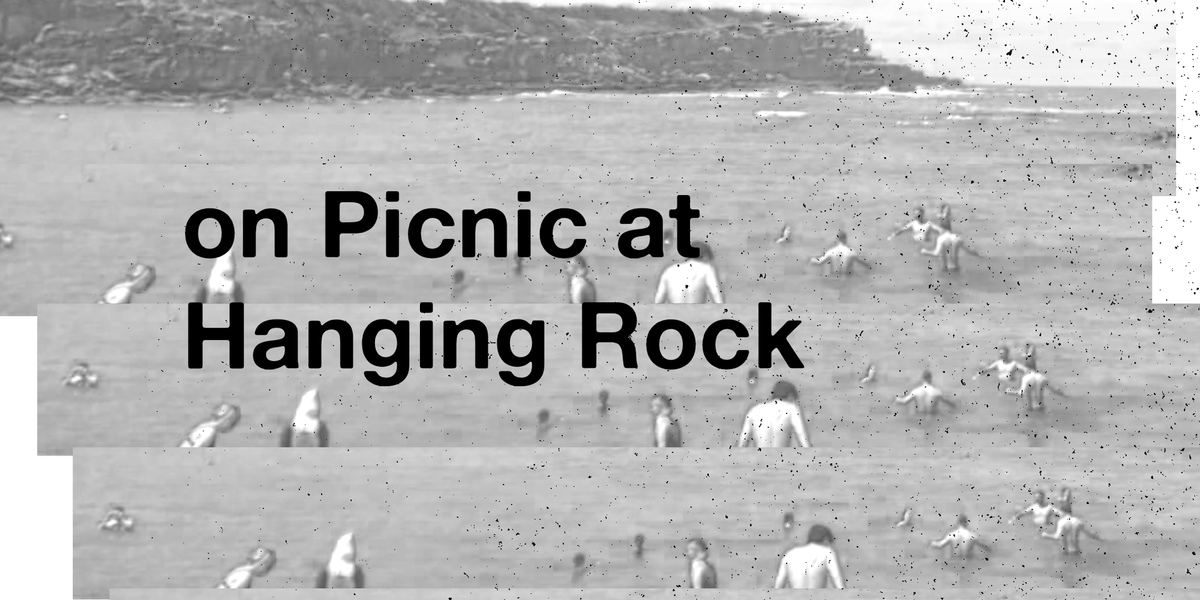
Picnic at Hanging Rock tells the story of the unexplained disappearance of 3 girls and a teacher from Appleyard College, a girls’ private school, while on a summer picnic. Following the girl’s disappearance, everyone descends into turmoil, driving themselves mad trying to figure out what the hell happened, and unfortunately, this descent extended to the lives of Australians in real life. Many people were deeply invested and wanted to know what happened to these three fictional girls, more than they did, say, about Australia’s own very real genocidal history, for example. Peter Weir’s direction of the film adaptation in 1975 came with the choice to personify the land, and specifically ‘Hanging Rock’ (traditional name Ngannelong) as a mysterious ‘other’, something that is inherently misunderstood, and something that reflects colonial Australia’s fears.
The film reiterates the idea that, to settler Australians, the outback is dangerous and unknown, perpetuating the white guilt of living on stolen land. Even in the exposition of Weir’s beloved classic, Appleyard College situated on groomed green grass is juxtaposed by the “harsh”, dry and overgrown outback; a clear statement that the imported institution doesn’t belong. As Douglas Keesey writes in his article Weir(d) Australia: Picnic at Hanging Rock and the Last Wave, “If Hanging Rock seems to loom menacingly over Appleyard College, it is because the Rock is a projection of white Australia's fears which, since they have been repressed, now appear to come at society from the outside, as something disturbingly other.”
Riding off the back of my Pasa Faho article, I highlighted how in Australia, we are in critical need of diverse art, whether film, TV, music, etc, to help us understand each other, and we need it like yesterday. We live in such a nuanced and multicultural country, and in saying that, I frequently think about colonisation in Australian art and how the history of this country impacts the art that non-Indigenous Australians produce.
At the risk of sounding incredibly inarticulate, and to put it plainly, the vibes in Australia are weir(d) 🤭 and if I’m being totally honest, the whole laid back “Australian” identity has never resonated with me (I think I came out of the womb with a stick so far up my arse it’s become a part of me). At the same time, I think it’s worth interrogating if it ever deeply resonated with anyone, or if it was just an easier alternative to **drum roll please** a shred of critical thinking and confronting the fear of the unknown. To me, although I am pro making things, making things in Australia can sometimes feel like writing on a piece of paper atop a shaggy carpet. I think that when I make things, on a subconscious level, I almost always revert to leaning into my family history and identity of Greek immigration, because aside from that, what does being a white Australian mean to me?
My immediate thought and idealised vision of Australian Cinema is that we Ctrl-Alt-Delete the ‘white assimilated, laid back, Aussie flag’, Australia that was curated and sold to so many in this country. We should opt instead for further integration of Indigenous Australian history and cultural practises, whilst also celebrating the multiculturalism in this country. But, given the One Nation party’s steep incline of popularity as of late… I’m feeling less than optimistic right now. I’m feeling a little 🤡💀.
Circling back to the article titled with maybe the best pun ever, Keesey also speaks to Freud’s concept of uncanny, which is essentially when something feels strangely familiar but disturbing. In the case of Keesey’s article, he describes Australia as having a sort of National Uncanny, and that films like Picnic at Hanging Rock and The Last Wave, “are haunted by the uncanny in the homeland they are in the process of defining… [and serve as] demystifications of the very myths that give white Australia its identity.” The film is uncanny because it presents to us a landscape that is familiar, the vast, beautiful Australian outback, in a way that isn't, with “hanging rock” being dangerous, uncontrollable, and unfamiliar. It extends to the uncanny history of Australia, and questions white Australia’s supposed ‘control’ of the land and their right to be here. In Picnic at Hanging Rock, the land fights back against its own colonisation - with Weir actualising the implicit fears of the time.
I am constantly questioning whether as white creators, we can ever produce art that isn’t tainted by the lens of colonisation?
I don’t have the answers because I consider questions more my specialty, so I went straight to the source (reddit 😍), which didn’t work because almost every thread was just white creators asking if what they’ve made is appropriation. SO. Maybe we are all as clueless as each other?
I continue to make things regardless, as a means for me to understand how I feel about the world, but I question my subconscious all the time and the more that I learn about anything, the more I feel I don’t know. But still, I think it’s a discussion worth having and again speaks to what the process of decolonisation in Australia looks like, which to me is an ongoing, active process of learning and unlearning.
Picnic at Hanging Rock serves to destabilise the perceived Australian national identity that so many other films of the time built up, and in doing so, inadvertently challenge our perceived idea of what it means to be an Australian. By recognising our national obsession with three girls that were LITERALLY fake (haters will say it’s based on a true story, but that’s loosely if true and beside the point), I think it points to the National Uncanny that settler Australians of the time could relate to, conscious or not, these films offered a glimmer of truth to our perceived national identity. Australians need diverse media, and given our current political polling, we need it now more than ever.
References
Bergo, C. (2019, December 22). White vanishing and settler colonial anxiety in the 1975 film Picnic at Hanging Rock. Visual & Material History Working Group Blog. https://blogs.eui.eu/visual-material-history/white-vanishing-settler-colonial-anxiety-1975-film-picnic-hanging-rock
Coghlan, J. (2025, August 10). Picnic at Hanging Rock is just as unsettling and relevant 50 years on. ABC News. https://www.abc.net.au/news/2025-08-10/picnic-at-hanging-rock-50-years-old-film/105628154
Keesey, D. (1998). Weir(d) Australia: Picnic at Hanging Rock and The Last Wave. Taylor & Francis. https://digitalcommons.calpoly.edu/cgi/viewcontent.cgi?article=1072&context=engl_fac
Comments ()