
The Secret Agent by Kleber Mendonça Filho (2025)
The Secret Agent is a masterful film about a period of history that couldn’t be more relevant to today.
Watched by Matthew Donlan at the Ritz
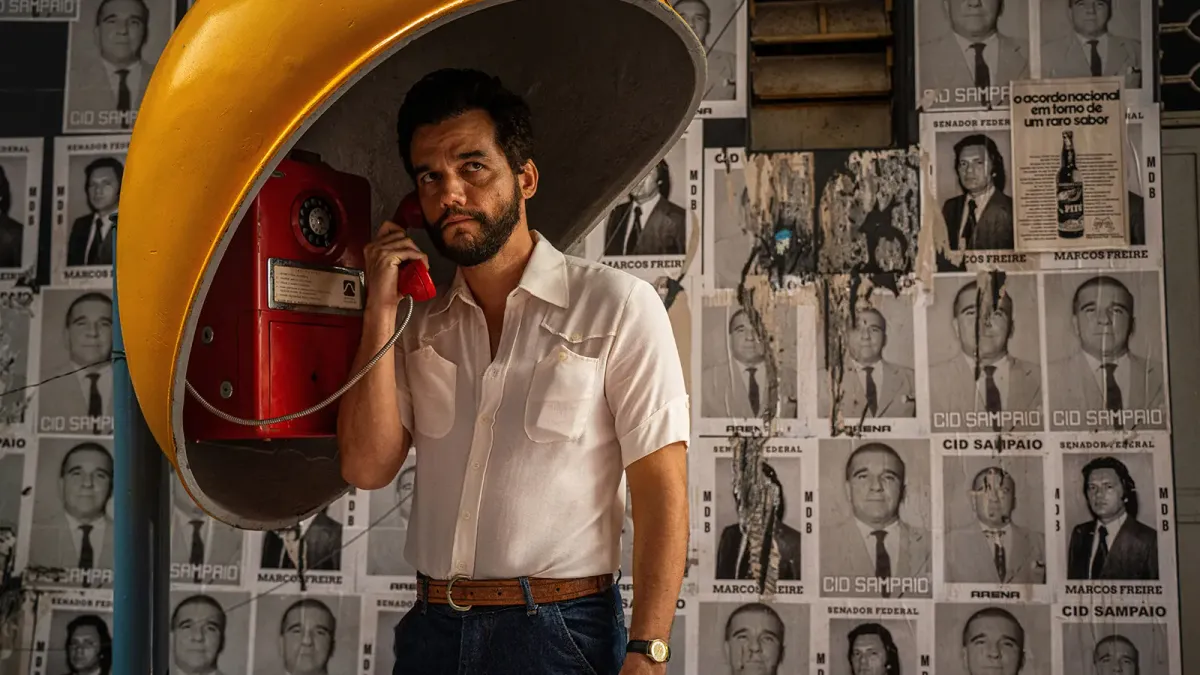
In his latest film, director Kleber Mendonça Filho paints a tableau of Brazil, and more specifically his home city of Recife, during the Brazilian military dictatorship. Eschewing typical genre classification, The Secret Agent conjures an atmosphere akin to memory across its nearly 3-hour runtime. It is centred on Armando (Wagner Moura), a former university professor who has now gone into hiding to escape punishment from the country’s dictatorship. In Recife to re-connect with his son, Armando finds protection from unlikely companions as he waits for a chance to flee the country.
It begins with Armando arriving at a rural petrol station to see a dead body lying in the carpark. Baking under the hot Brazilian sun for days, the body has attracted flies and wild dogs. Weighed down by a few rocks, a thin piece of cardboard covers the body in a low-effort attempt to hide the truth. This is the Brazil of 1977. Under the vibrant sun and amidst the buzz of carnival, just beneath the surface, is a rotting corpse of corruption. It is a stench that permeates through the film and across decades as the reach of state violence is slowly revealed.
The heat of Brazil melts through the screen with gorgeous orange hues soaking the film. Shot on vintage Panavision cameras, the film fills the widescreen with characters and details that authenticate its setting. The film is not just set in 1977 but draws its filming and editing techniques from the time too. It has the effect of feeling both incredibly modern and aged, like a deep memory being drawn to the surface again. Strikingly, the film makes full use of several split diopter shots. In their use they bring to focus characters at starkly different depths. It presents both their faces, often in conflicting emotional responses, at the same time to enhance the tension. It is an effective and subtle way of enhancing the atmosphere of multiple perspectives on the same moment.
At the heart of this film is memory, both individual and collective, and how this can be warped by others. The script, a confident and carefully considered piece of writing, deserves your trust as it replicates this experience. Its first act is surrounded by mystery and questions of who, what and why. It may be tempting to become frustrated with the lack of information provided from the outset as you try to piece together how all these characters are connected. But it is important you let yourself be swallowed by its atmosphere as the story unravels before you. The script is constructed this way to mimic the sense of confusion and frustration Armando faces as he is forced into hiding for incomprehensible reasons. The releasing of details out of order has the effect of constantly redefining previous moments, building a nuanced and lived-in world. It begins to paint to the audience just how one event can be interpreted and construed in various ways by those involved.
Perhaps the most striking demonstration of this effect is the story of the re-animated leg. Drawn from media reports in Recife from the time, the ‘hairy leg’ that kicks people in the park is an urban legend made true. In the film, a dismembered leg is found in the body of a shark. Corrupt police dispose of it, only for the leg to wash ashore, come to life and attack gay men late at night in the park. Reported in the next day’s newspaper, it is a false memory made true. Capitalising on the public frenzy around ‘Jaws’, the hairy leg reveals how memories can be conjured out of thin air to cover up a grislier truth, the police violence against innocent people during carnival. Yet the leg also represents another fact – that this past cannot remain buried and will always find a way out.
Armando’s life is another memory made true and uncovered years later. In tiny snippets scattered through the film, we see two young researchers listen to tape recordings on their laptops, taken from witnesses in Armando’s life. Audio from scenes we have just watched pause and play through their earphones, the wavelengths running along their screens. It brings a sense of fatedness (particularly for those familiar with Brazilian history from this time) as it abstracts Armando’s life to raw pieces of media. It both reduces him to a microcosm against the grander forces at play and rejuvenates his story to greater importance. As we return to Armando’s story after these interstices, we watch him exert what little control he has over the situation while knowing there is already an end.
The Secret Agent is a masterful film about a period of history that couldn’t be more relevant to today. See it now in general cinemas.
Pick of the Week
I started the Fleapit to showcase indie and Australian works, so there is no better way to support both than by going to the 'Movie Juice' On Tour screening next Wednesday (11 Feb). Hosted by Pink Flamingo and the Underground Film Collective, the night includes 4 films made by the Adelaide-based film collective, Movie Juice. Tickets are only available at the door!
Just Dropped
The French Film Festival has just released its full programme, running in Sydney 3 March - 8 April. The festival is leaning into comedies with Colours of Time opening the 4-week long programme and The Richest Woman in the World as its centrepiece. For those familiar with recent French indies, the festival will host the Australian premieres of new films by Francois Ozon (The Stranger) and Julia Ducournau (Alpha). The full programme can be seen here with tickets on sale tomorrow (Thursday 5 Feb).
New Releases: Thursday 5 February
- We Bury The Dead (Zak Hilditch) (AUS)
- Saipan (Lisa Barros D'Sa, Glenn Leyburn)
- Is This Thing On? (Bradley Cooper)
Looking for the weekly guide? It's relocated into the regular newsletter. Subscribe to get curated recommendations or follow the Fleapit on Instagram to see the highlights of each week!
Comments ()