
Alpha by Julia Ducournau (2025)
Less body horror, and more body haunting...
Watched by Matthew Donlan
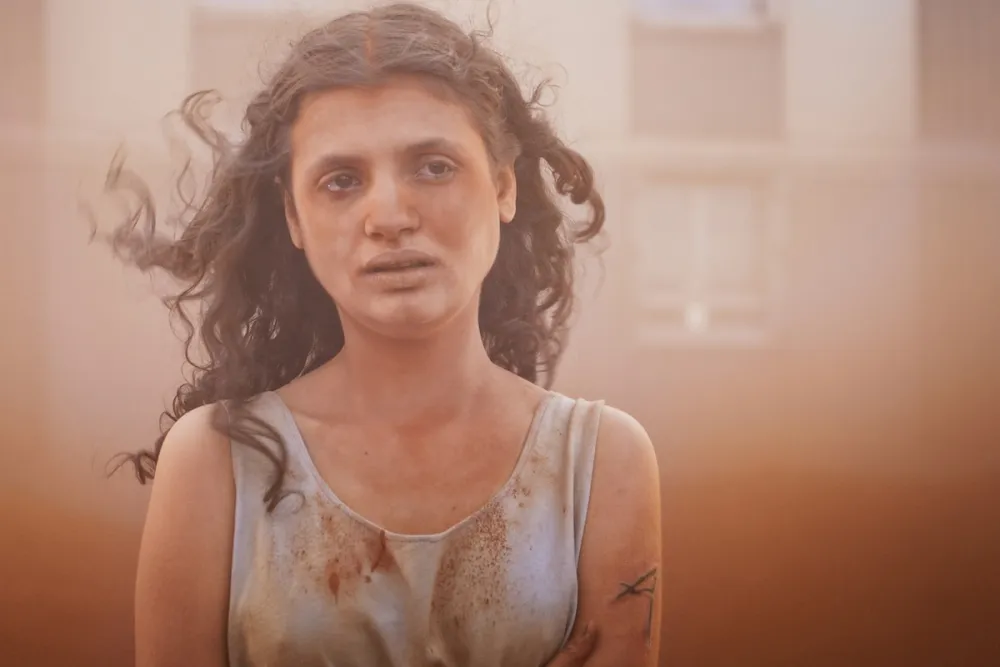
Whatever expectations you have for this film, you should abandon. Whatever preconceptions of Julia Ducournau’s work you hold, you should let go. Alpha is unlike Ducournau’s previous works, Raw and the Palme D’or winning Titane. It is not a body horror as we’ve come to expect from her but instead a family-centred haunting. And one which will polarise viewers but (hopefully) leave them moved.
Alpha (Melissa Boros) is a 13-year-old girl living with her single mother (Golshifteh Farahani) in France. Her mother is un-named. The town is un-named. The time period is unspecified. This withholding of information narrows our focus to what matters. What is clear is the strong relationship between Alpha and her mother, a nurse working overtime in a sparsely staffed hospital amid a strange pandemic. Patients are appearing with unusual symptoms. Extreme weight loss, shiny marble-like skin, rigid joints, dust cloud coughs. They appear to be turning to stone, crumbling into dust.
Alpha comes home from a party with a stick-and-poke tattoo, and her mother is immediately alarmed. Could she have contracted the virus from this unsanitary needle? While in a limbo awaiting results, Alpha’s uncle, Amin (Tahar Rahim) seemingly re-appears after years away to stay with the family. A heroin addict, Amin’s presence unsettles Alpha, but her reassuring and protective mother promises things will be okay.
At school, Alpha’s potential infection causes alarm and bullying. As she bleeds on gym gear and test papers, her classmates isolate her for fear of falling ill. Even Alpha’s secret lover, Adrien, oscillates between care and concern as the fear infects their relationship too. The only source of sympathy is her English teacher. An unspoken understanding is shared between them, a common experience which must go unaddressed.
Alpha is a film that refuses to live in the literal. It is deliberately elusive on details, relying more on its visual style than exposition. Strong reds and blues in costumes and sets help to distinguish the past from the present, but even then, timelines begin to blur and specifics become hazy. The point isn’t to know whether what we are watching happened to 5-year-old Alpha or 13-year-old Alpha. The point is to know that it happened and, at least for her, continues to happen. It drives home the notion that trauma at a young age will stay with you. That it will infect you and affect you in ways that are hard to explain. It appears in moments of vulnerability and fear.
The inexplicable virus that is ravaging otherwise healthy people is just another example of this film’s abstractness. While evoking similar sentiments to the AIDS crisis, Ducournau has pushed back against this comparison. It is not designed to be a recreation but an evocation. It elicits fear in the community, and this fear is what Ducournau is more intrigued by. How fear provokes people to bully, ostracise and demonise others for things out of their control. How ignorance is used as a defence. Fear is the thing made ugly by this virus.
Conversely, the thing made beautiful by the virus are its victims. By transfiguring the victims into stone statues, Ducournau immortalises and beautifies their suffering. With skin like Greek marble statues, the victims are preserved and memorialised. But like those caught in the ash of Vesuvius, their bodies are fixed in curled positions of pain, mouth agape in agony. As their skin turns to stone, their blood turns to sand and pours out like that of an hourglass. It links back to Poe’s poem recited early in the film by Alpha’s English teacher. The author stands on a shore and grieves the sand slipping through their hands. They lament their inability to hold on and question if it is all “a dream within a dream?”
This scene is manifested in the film’s audacious final act. As the sand meets the sea, Alpha and Amin face the consequences of decisions made by them and by others. The blistering wind picking up red sand and blanketing the town sweeps through like a haunting. These visual moments are Ducournau’s strength. Like her previous works, the bold evocative imagery persists in your mind and create an unsettling feeling long after the film.
In a haunting final shot, like that of a weeping Madonna, we too wonder if it was all a dream.
Alpha is screening at the Alliance Française French Film Festival
Pick of the Week
The launch of the Sydney Cinémathèque is here! On Saturday, you have the choice of Starstruck or Priscilla, but on Sunday are the real hidden gems. The day includes a fine selection of short films and an incredibly rare chance to see the work of Paul Winkler. Details are available here.
New Releases - Thursday 5 March
- Plainclothes (Carmen Emmi)
- The Voice of Hind Rajab (Kaouther Ben Hania)
- Mr Nobody Against Putin (David Borenstein and Pavel Talankin)
- Midwinter Break (Polly Findlay)
- The Moment (Aidan Zamiri)
- The Bride (Maggie Gyllenhaal)
- How to Make A Killing (John Patton Ford)
- Peaky Blinders: The Immortal Man (Tom Harper)
Looking for the weekly guide? It's relocated into the regular newsletter. Subscribe to get curated recommendations or follow the Fleapit on Instagram to see the highlights of each week!
Comments ()