
Amrum by Fatih Akin (2025)
A simple journey for food becomes life or death during WW2...
Watched by Matthew Donlan at Palace Cinemas
Amrum is a small island in the Nordfriesland district, off the coast of Germany. Located in the North Sea, the island is only connected to the mainland via a ferry. The population, only roughly two thousand, maintain a dialect called Öömrang and several Frisian traditions. The entire west coast is one long beach which faces out to the sea, and its east coast faces mud plains. The soil itself is unfertile for agriculture, with the location relying today on resort tourism. It is a quiet, secluded, disconnected and tranquil spot.
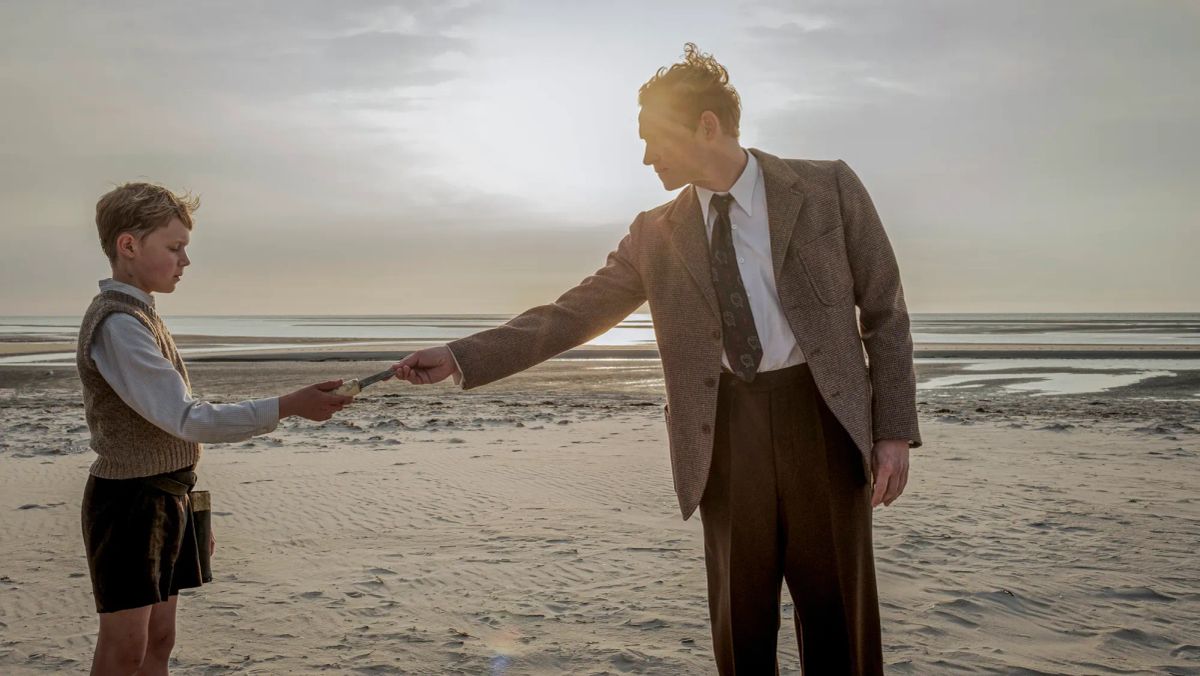
But, in 1945, not even Amrum's distance from the nation's capital could keep it safe from the ugly tendrils of fascism. On this remote island, where Nazism found a home in the barren soil, one of its saplings, 12-year old Nanning, is to face a trial of morality. With his father serving in the war, Nanning has become the man of the house. He is a loyal member of the Hitler Youth, but this commitment proves a barrier at the announcement of the fuhrer's death. The rest of the townspeople, after years of hardship, have already begun to build a life post-Hitler. But Nanning's mother could not conceive of such a future. After giving birth, she enters a deep depression and craves a precious gift during the time of harsh rations; white bread with butter and honey. What feels like a simple request becomes Nanning's raison d'être, as he barters, borrows and dashes across the island to fulfil his mother's wish.
Fatih Akin's latest film, Amrum, is a departure for the Turkish-German director. His previous films, having won the Golden Bear, the Golden Globe and Best Screenplay at Cannes, are known for their forcefulness and intense political themes. They happen in the here and now, calling out the racism and bias of contemporary Germany. So to step back 80 years may seem like an odd move, but one that makes sense when you learn its origins. Amrum was written by Akin's friend, longtime collaborator and mentor, Hark Bohm, and is based on his own childhood on the island. In his later years, with ill-health affecting his ability to work, Bohm asked Akin to bring the project to life. And he has done so with a tenderness rarely seen in his catalogue.
Like the island itself, the film is a quiet, reflective and tender experience. The camera gently tracks and scans across the landscape, not making a fuss over its beauty but letting us appreciate it nonetheless. The range of fauna photographed too is remarkable but treads close to a tourism campaign if it weren't for the story being told alongside it. In this way, the island becomes a character as much as Nanning and the townspeople. It is both a victim, perpetrator and witness to the effects of the regime. Its shore washes up decaying corpses of pilots. Its animals are killed to feed the starving populace. Its rising tides become traps for unsuspecting newcomers. The island holds its breath and suffers with its inhabitants, only really letting out a sigh of relief in the film's closing moments.
Through Nanning's journey, we're witness to the pervasiveness of the regime and its ability to alter lives. At 12 years old, Nanning is at the cusp of forming his own world view. After years of being told what to think, there is a chance that this harmful indoctrination will persist, but underneath it is an empathy. This is the battle which unfolds internally as we witness Nanning consider stealing food or whether to rescue his would-be bullies from harm. While small, inconsequential moments by themselves, together they present a life-or-death turning point for the young boy. The regime has taught him that showing care for others is a weakness, and yet the town seems to be improving as it bands together around the newly arrived refugees.
Like a traditional parable or fairytale, told in a traditional way, Amrum's lessons lie in the connections to today. With fascism on the rise again in Germany, another young generation is being fed harmful lies and worldviews. They are being told to crush their own moral compass in pursuit of power and might. Amrum reveals that this way of thinking will always come to an end and beauty will emerge again. The sooner we reach that beauty, the better.
Amrum is the centrepiece film at the German Film Festival, running 6-27 May in Sydney.
Pick of the Week
I know Sunday is Mother's Day, but if you don't have plans, make sure you head to the Sydney Cinematheque to see Leichhardt on the big screen twice! Rats in the Ranks and Death of an Undertaker both screen on Sunday, and the latter includes a Q+A with the director!
New Releases - Thursday 7 May
- DJ Ahmet (Georgi M. Unkovski)
- The Sheep Detectives (Kyle Balda)
- Mortal Kombat II (Simon McQuoid)
Looking for the weekly guide? It's relocated into the regular newsletter. Subscribe to get curated recommendations or follow the Fleapit on Instagram to see the highlights of each week!

Comments ()