
Taking Care: Alex Juhasz’s Please Hold
a beautiful reminder of what art can be...
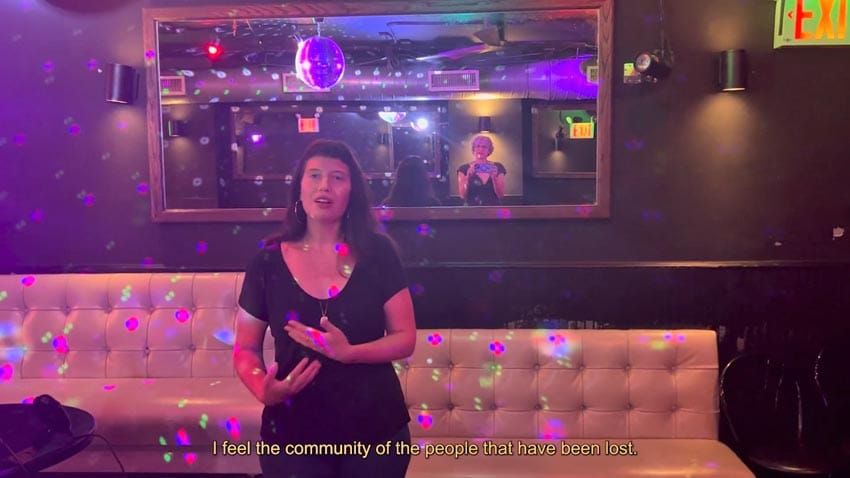
Watched by Calum Nolan at UNSW Sydney
You know you’re in rarefied company when the clock ticks ten minutes past 3pm on a Saturday, and a touch more than a handful of strangers are nervously tapping their feet, waiting for the harsh LED downlights to go down in a small cinema on the third level of the Robert Webster building at UNSW. There’s whispered conversation between the select few people who know each other - the teachers and academics - but the rest look at their feet, or the thick, velvet red curtains that do a bad job at blocking the afternoon light, hoping these things might be imbued with some hidden intellectual or aesthetic value they were yet to uncover. Cinephiles know that looking is durational. The longer you persist, the more is revealed.
Alex Juhasz is a moving image artist and Distinguished Professor of Film at Brooklyn College, CUNY. If you’ve encountered her work, it’s most likely through Cheryl Dunye’s 1996 film, The Watermelon Woman, which she produced. If you’re like me, the rest of her decades-long catalogue of moving image work, scholarship and activism (though with Juhasz, the three seem inseparable) lay too far outside the canon to stumble across. The opening shot of Please Hold, however, made it very clear that the canon was never somewhere Juhasz aspired to be, and reflecting on the screening, I wondered whether the place that Juhasz had carved/is carving out for herself, her community, her work, is an altogether more interesting, more meaningful place.
Place was the central theme of the work, yet this investigation didn’t begin in the filmic space, but in the actual, living space in which the film was being screened. Juhasz introduced the film by asking each person in the small audience to share a word that captured what was conjured up for us by the notions of ‘holding on’, or ‘letting go’. And so we went around, one-by-one, each person sharing a word, or a few. This act of infusing the consuming space with just a little extra time, and care, transformed the atmosphere, and energised people (I think, going off vibes here) to engage with the film actively. Immediately, strangers become humans and neighbours; something a film has the power to do in and of itself, but to have it spoken, explicitly recognised, this was something wholly different and new. From these words emerged one of the film’s key tensions - that holding on and letting go are perhaps two sides of the same coin.
A vertical slab bisecting the centre of the screen, flanked by two columns of black. Shot handheld on an iPhone (also the sound recording device), by Juhasz, we walk with her on a grey New York day, towards a hospital where her friend is dying, as she narrates from behind the camera. Sitting in a cinema, watching on a big screen, there is an immediate tension between what you think a film is, and what is playing out in front of you. It’s notable, in this regard, that Please Hold is characterised as a video, and not a film.
The documentary traces the lines sprawling between two moments in Alex’s life: when her best friend, James Robert Lamb, dying of AIDS, asked her to videotape some of his last moments on Earth, and when, almost thirty years later, her friend Juanita Mohammed Szczepanski asked her to do the same. What does it mean that her friends both asked this of her? The answer comes in the form of VHS videotapes, iPhone footage, and Zoom recordings, what Juhasz called the ‘detritus’ of media technologies. These dead leaves, however, are crafted with both precision and care, orbiting around the film’s hallmark motif, the vertical iPhone which walks down New York streets. Juhasz’s off-screen narration, remembering and reflecting, pulls the audience into the questions she seeks the answers too. What does it mean that we walk around with ghosts in our pocket?
A work that swims in the grief of losing two dear friends, with personal footage no less, it would have been all too easy to make a film that asks your sympathy for its own sake, and many have done it before, wanting you to grieve for it, rather than with it. But the film is less about Juhasz’s grief, than where that grief is stored. Sweaters, apartment buildings, queer bars…video. Juhasz wants you to reflect on these objects alongside her, in whatever form they take in your own life. The excellence of the storytelling despite, or regardless of, the choice to craft the film from ‘detritus’ media, challenges the normative modes of film and moving image consumption.
As audiences we’re becoming increasingly acclimatised to aesthetically agreeable, though ultimately sterile images. Red-yellow-blues graded down to the pixel. Lightning fast, razor sharp lenses are so often unimaginatively wasted on a succession of stunning close-ups punctured by precision-engineered bokeh and flares. These images assume so much of you; what you like, what you want to see, what you’ll be impressed by and, ultimately, what you’ll be moved by. Somewhere amongst these assumptions and presuppositions, these data-driven dreams where people are no more than a selection of key demographic variables, the intentions of the filmmakers fight for each breath.
So to experience a work grounded in intent, that is resolute on not having that intent lost in translation from maker to audience, that is conscious of the contexts and communities in which it is consumed, was a beautiful reminder of what art can be, why we need it, and why we need to make it. Please Hold is a lesson in taking care. Juhasz’s care-oriented practice urges us to look at the people in front of us, to hold onto our communities, to the treasure trove of media that may still, in some way, contain the seeds of connection and not just separation.
Please Hold is available to watch through Alex Juhasz’s website: https://alexandrajuhasz.com/ - Her only wish is that you watch it with others.
Pick of the Week
My pick of the week has to go to one of my all time favourites, Close Encounters of the Third Kind, playing at the Orpheum on Friday. It is such a magical and tender film!
New Releases: Thursday 28 May
- Backrooms (Kane Parsons)
- Power Ballad (John Carney)
- H Is For Hawk (Philippa Lowthorpe)
Looking for the weekly guide? It's relocated into the regular newsletter. Subscribe to get curated recommendations or follow the Fleapit on Instagram to see the highlights of each week!


Comments ()