
Interview: James J. Robinson and First Light
Ahead of First Light's cinema release, the director discusses the discovery journey he went on while making the film...
Conducted by Matthew Donlan
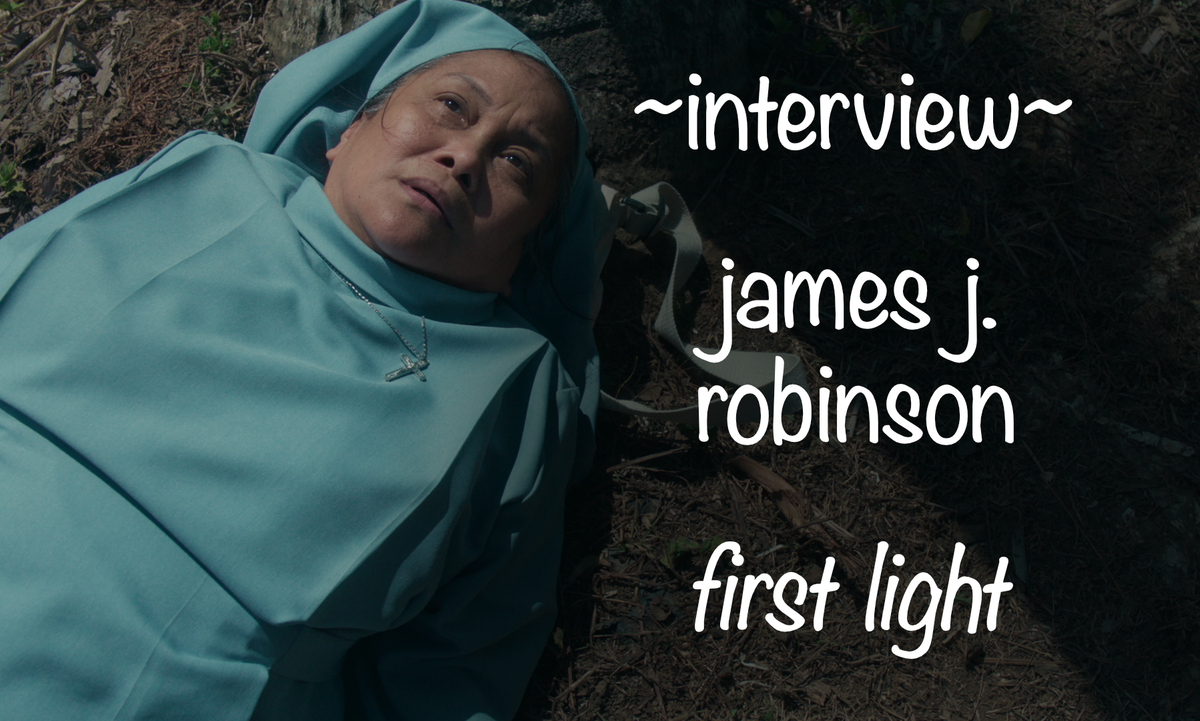
First Light, directed by James J. Robinson, follows a Filipino nun as she goes through a crisis of faith. Transcendental, reflective and stunningly-shot, the film demands audiences to consider the moral complexities of faith, colonialism, capitalism and how they affect the individual. It is a beautiful and moving film, and hits Australian cinemas on Thursday 9 July.
Ahead of its release, I had the pleasure of chatting with James about the tensions of the film, connecting with his home and being the first Australian-Filipino co-production.
Firstly, I wanted to say congratulations on the film. It’s so beautiful and mature, and I’d like to start with the script itself. There are a lot of dualities in this film; tensions between old and new faiths. You said in the introduction at Sydney Film Festival that the film has its origins in response to the Religious Discrimination Bill, but I was curious about the tensions that you were working through as you were developing the script.
Everything in the film needed to have some kind of balance. That’s something that I’ve observed in the natural world and therefore it's something that I wanted to endow the film with. There are a lot of dualities for me, when I was writing the script of playing with my Australian heritage, but also my Filipino heritage, playing with the parts of myself that feel more feminine and the parts of myself that are more masculine.
That was something in the very first document that we sent to Screen Australia, that this film for me is unpacking what it means to have two parts of my blood, one side living on stolen land and being a coloniser, but then on the other side, being the colonised with my Filipino heritage. They're all these different dualities that I was trying to play with within myself and trying to strike the balance in.
That was my way of trying to make sure that I wasn't communicating in a didactic way and in black and white because that is such a Catholic teaching with heaven and hell, right and wrong, but that completely ruins the beauty of living on this planet. Things aren’t black and white and that’s what makes them beautiful.
The Religious Discrimination Bill is the emotional core of where the film came from. I was feeling a lot of anger. And then the balance and duality of that came in this ultimate depiction of grace. Can I capture grace still existing in this anger that I'm feeling? And what does that grace look like? And to me, having a Filipino mum and having these aunties around me who were embodiments of that kind of grace, naturally, that's where the character ended up gravitating towards.
And you talked as well about working through your identity because another thing that stood out in this film was the feeling of home. For Sister Yolanda, when she goes back to the rice fields, that serves as a moment of restoration for her. When you were working on the film, I know that there was a lot of research going into it about Filipino culture and colonisation and I’m curious about that process for you, that connection of home while you were working on this film and how that bled into the film itself.
I love that question. That really was so much of it. When making the film itself, I know that as a filmmaker, it is completely pointless to try and make a film for the purpose of evoking a particular response or having a certain level of success or winning awards. You don't know how films will turn out, and I need to surrender to that, so in making the film, I needed to make sure that the very process of creating it was going to be satisfying.
Returning to the Philippines was going to be the point of the film, almost more so than the film itself. In the past, I'd come to the Philippines just to visit family, but I never really got the chance to embed myself deep in Filipino culture that is pre-colonial.
And then extending that, it's an interesting thing growing up in Australia and growing up on Stolen Land. What is home? How much do I connect to? What do I connect to? I think we all have that question of identity and how we fit into a country because the history is so recent.
In Australia we're so accustomed now to a Welcome to Country and in the Philippines, when we started shooting, I wanted to do that same thing. If we're going to be shooting in these ancestral lands where colonisation didn't totally touch for a long time, I wanted to ask permission to be here. We did this ceremony (cañao) with a mumbaki and we asked permission from the gods and the spirits if we could be shooting on that land.
That experience of performing that ceremony and asking permission to be there and having permission from my ancestors to do that was very much a reflection of that journey of Sister Yolanda back to the rice fields of being like, she grew up in this place. But for most of her life, she's lived in this convent, so returning to her home and remembering the memories of her own life and a national memory, that's where the ultimate lesson comes from. It doesn't come from this new thing.
We are part of this greater human story where all these issues that we face, whether that be a wealth gap or politics and government, are questions that our ancestors have had to deal with before. And it takes us returning to history, remembering of home to find the answers to those questions.
Sorry for such a long answer.
No, it's a great answer because that comes across in the film as well. And then with the camerawork every shot, every composition is gorgeous. And the film is a slower film because of that. I was curious about the decision to slow things down through the film and how that impacted production and performance?
I think in the films that I love the most, there is a slow pace and a grace. While in my work in music videos it requires this faster pacing to keep audience engagement, I found graduating into the world of feature filmmaking meant that I could take control and remember what my inspiration is. So much of that comes from Edward Yang and Tsai Ming-liang.
But when we got to financing, we could only afford one camera set up, unless we went with cheaper cameras, so my cinematographer and I were like, let's not see that as an obstacle and instead find how we weave that into the language of what we're trying to do.
If we had to do this scene from one angle, what is that angle and how can we block the characters out so that rather than moving the camera, our characters can move through the scene and through the set in a particular way instead of cutting.
That ultimately just worked because at the end of the day, the story is being told from the perspective of this nun. She's in basically every scene, every shot. I need to respect that. This film is unfolding from her eyes and not mine. That language and that slowness, really captures the observational eye of a character who is probably used to being overlooked and is like a wallflower.
What has the reception been like to the film in different places, both in terms of themes and that slower style?
Being here in the Philippines right now, this is the audience. The Australian audience was an important one to me, but I think the most important one was how is it going to be received in the homeland? And it's been really great.
People have engaged with it, and people get the references to really small things in Filipino culture. People in the questions like bringing up words like kapwa, which is an indigenous Filipino word for the way that you take care of community. That’s an important word to me that I had on the wall above me when I was writing the whole screenplay.
At the same time the standard mainstream media here is like Hollywood on crack in that it's ten times as fast as it is in Hollywood. They all grew up on soap opera storytelling so to use some actors who have been in those soap operas but put them in this slow film, this slowness has been a thing that becomes one of its strongest things for arthouse audiences.
In Australia, audiences are intelligent and maybe really excited by the government trying something a little bit different with our cinema background. The Netherlands was an awesome country and the response was amazing, the way of seeing specific camera choices I made was mind blowing. And then in Morocco, because it's predominantly an Islamic country it was a lot of questions about the morals of the characters.
Knowing that every audience seems to respond to it, although in different ways, is a sign that the universality exists.
On Screen Australia, this is the first Australian/Filipino government co-production. What does it mean to you to have achieved that, and what do you think that signals about the direction of the film industry?
It feels amazing! When I first decided to go to Screen Australia to finance this, it felt like something that I assumed wasn't going to be possible. They had funded films like Tanna, which was mainly in Vanuatu, or Buoyancy, which was in Lao. I saw what they've done before and thought I'd love to apply that same idea of shooting in a country in Southeast Asia, but with somebody who understands the culture in their blood but to be the first one is special. Screen Australia was so supportive from the beginning. They funded us in our first round, which is quite competitive for development and so that was their trust in the film from the beginning.
Then it came down to some finite questions. When we started doing our funding, they’d say you're going to be shooting in a country that we don't know and we don't understand. What if you have to pay bribes? Those direct questions came up from the cross-cultural thing, which I understand to a degree.
But we had to have our Filipino producers calm them down. One of my producers, was a production manager for the Philippines leg of Avengers when they shot in the Philippines. She'd worked with the big million-dollar budgets before from Hollywood and still Screen Australia was like, I don't know, what if this happened? But it's all just cultural relativism. I can't blame Screen Australia for having those questions.
The benefit of now having gone through that is we seem to have relaxed Screen Australia a little bit more into co-production financing for countries that they haven't before. It speaks to the general globalisation of cinema in general. Australia needs to keep up with that if it wants to keep its film relevant. Australian cinema is so important to me, obviously coming from Australia, and I want to see nothing more than the industry to just continue to thrive and get bigger and bigger.
Final question and I ask everyone this. The goal of the Fleapit is to support Australian works, underappreciated works, things that go under the radar. And I want to give the platform to you. What are some of the films that you think people should be talking about more?
There's a film called Shame (Steve Jodrell, 1987), which no one talks about it. It’s one of the best films I’ve ever seen in my whole life. That is one Australian film that I will go to my grave saying, this is so freaking good.
Another one I saw at the Shanghai Film Festival. The National Film and Sound Archive of Australia was doing a presentation of Storm Boy (Henri Safran, 1976). I got to watch that with a Chinese audience on the biggest possible screen you could imagine.
And then give me three seconds to go through my Letterboxd…
I'm just going to end it on one random one. There’s a documentary from a few years ago called Feels Good Man (Arthur Jones, 2020). It's a very random choice for me right in this moment but it is one that is in my all-time favourites. I just had my jaw on the floor. What I love about it, is obviously the tongue-in-cheek Pepe the Frog, but the actual underlying commentary on the direction of the internet and post irony is terrifying and funny but is something that I want people to see.
I was not expecting that but thank you so much for chatting.
Thank you so much.
First Light is in Australian cinemas Thursday 9 July.
Pick of the Week
There's quite a few Aussie films on screens this week! Along with First Light is body-horror Saccharine. Leviticus has a few Q+As around Sydney, and Going Down still has a screening at Golden Age.
New Releases - Thursday 9 July
- First Light (James J Robinson) (AUS)
- Saccharine (Natalie Erika James) (AUS)
- Evil Dead Burn (Sébastien Vaniček)
- The Invite (Olivia Wilde)
Want a weekly guide that tells you what's happening on Sydney screens? Subscribe (for free) to get hand-picked recommendations or follow the Fleapit on Instagram to see the highlights of each week!

Comments ()